September Cat News: Blueberry and the Granola Bars

We have some exciting news this week! Blueberry won 6th place in the Appalachian Great Pyrenees Rescue Calendar contest! This means he will be featured on the May issue of the 2024 calendar. This is a fundraiser we participate in every year for the rescue where we got Blueberry.

Times are super tough right now due to the number of Pyrs being surrendered and the rising costs of inflation, so if you have a couple extra bucks, please consider donating.

To celebrate his exciting calendar contest win, Blueberry did a Blueberry thing, and got into the granola bars *again*. This time he only consumed 8 (last time was 17) apple flavored ones. We took him to the vet (because the doofus swallows them whole), and discovered that he now weighs 165lbs (and is not overweight!)! "What are you feeding him?" they asked us. Obviously, the answer is granola bars! He successfully regurgitated the granola bars and we will no longer be buying them lol.

He is fully recovered, and we are carefully reevaluating our food storage choices.

How Often Do You Think About The Roman Empire?

A few days ago, my friend Sammy texted our group thread: "How often do you think about the Roman Empire?" I was not surprised when my spouse replied, "Every day," but my own answer was, "Almost never." Though I will confess, I think about it a lot more now that I'm married than I ever did when I was single—mostly due the the impromptu lectures on the Roman Empire I get from Josh on long car rides.

While not everyone specifically thinks about the Roman Empire on a daily basis, I bet you have something you think about uncommonly frequently too. Maybe it's bees (looking at you, Dad) or the inner workings of a guitar amp (looking at you, little brother), types of dirt (looking at you, Mom), or printing presses (looking at you, big brother).

For me, it's The Ship of Theseus.

If you're unfamiliar, The Ship of Theseus is a philosophical thought experiment, recorded by Plutarch. So yeah, it goes back a ways.

The story goes something like this. Theseus was the founder king of Athens, and after he slayed the minotaur (you may be familiar with the story of Theseus and the Minotaur?), he rescued the children of Athens and escaped on a ship to Delos. Every year, the Athenians commemorated this by taking the same ship—the Ship of Theseus—on a pilgrimage to Delos.

After a few pilgrimages, the ship returns to harbor with some damage, so a shipwright is hired to repair it. Luckily, the damage is minor so they only replace two planks of wood. The ship makes the pilgrimage just fine the next few years, but then, one year, it sails into a storm. The main mast is snapped, and upon the ship's return to harbor, the shipwright is forced to replace the mast, as well as quite a bit of the original wood of the ship.

After decades (or centuries) of this annual pilgrimage, many trips sailed through storms, regular wear and tear, and a few surprise pirate battles, every single plank of wood has been replaced. The original sailors are replaced with younger sailors. The masts are new. The sails are new. The nails are new.

Is it the same ship?

If so, what makes it the same if everything about it is different? If not, at what point did it stop being the same???

I don't know!!! But I love thinking about it. And applying the idea to other things.

For example, one of my neighbors wanted to edge her garden beds with uniform rocks. So rather than buying a bag of rocks from Lowes, she bought a bag of cement dust and made "rocks" with concrete and plastic bags.

Every time I walk past those damn rocks, I think about how they were originally rocks, then were ground into dust for cement, and then she added water... and turned them back into "rocks."

Are they the same original rocks?? Or are they new rocks???

I DON'T KNOW.

It's fascinating to apply to personal identity as well. For example, I was once five years old. I was a lot shorter back then. I had two sets of teeth in my skull. Turtles were a lot bigger. And I was really good at catching chickens.

Now, I'm a lot taller. I have less than one set of teeth in my skull, (no wisdom teeth), and turtles seem to have shrunken. I am not as good at catching chickens, though I'm pretty good at catching cats these days.

Add to that, that every cell of my body has been replaced roughly three times since then—

Am I the same as 5-year-old me???

I DON'T KNOW!!!

There are obviously tons of ways to answer these questions. But ultimately, there's not really a right or wrong approach. It all comes down to how you want to think about it.

I love thinking. It's one of my favorite things about being alive. And is probably why I've decided to write books—because writing books is basically thinking out loud so other people can read it. Of course The Ship of Theseus isn't the only random concept that plagues me. Pi drives me insane. The Trolley Car Problem? [Insert internal brain shriek here.] Birds. The shapes of things. Time travel. Ethics. My late mentor, Deidre. Trees. I think about trees a lot.

Anyway. What do you think about ridiculously often? Is it the Roman Empire? Or something else?

Writing Tips (Sometimes): Repetition, Repetition, Sweet, Sweet Repetition

This is part of my series of essays for writers. Get them delivered to your inbox by signing up here!

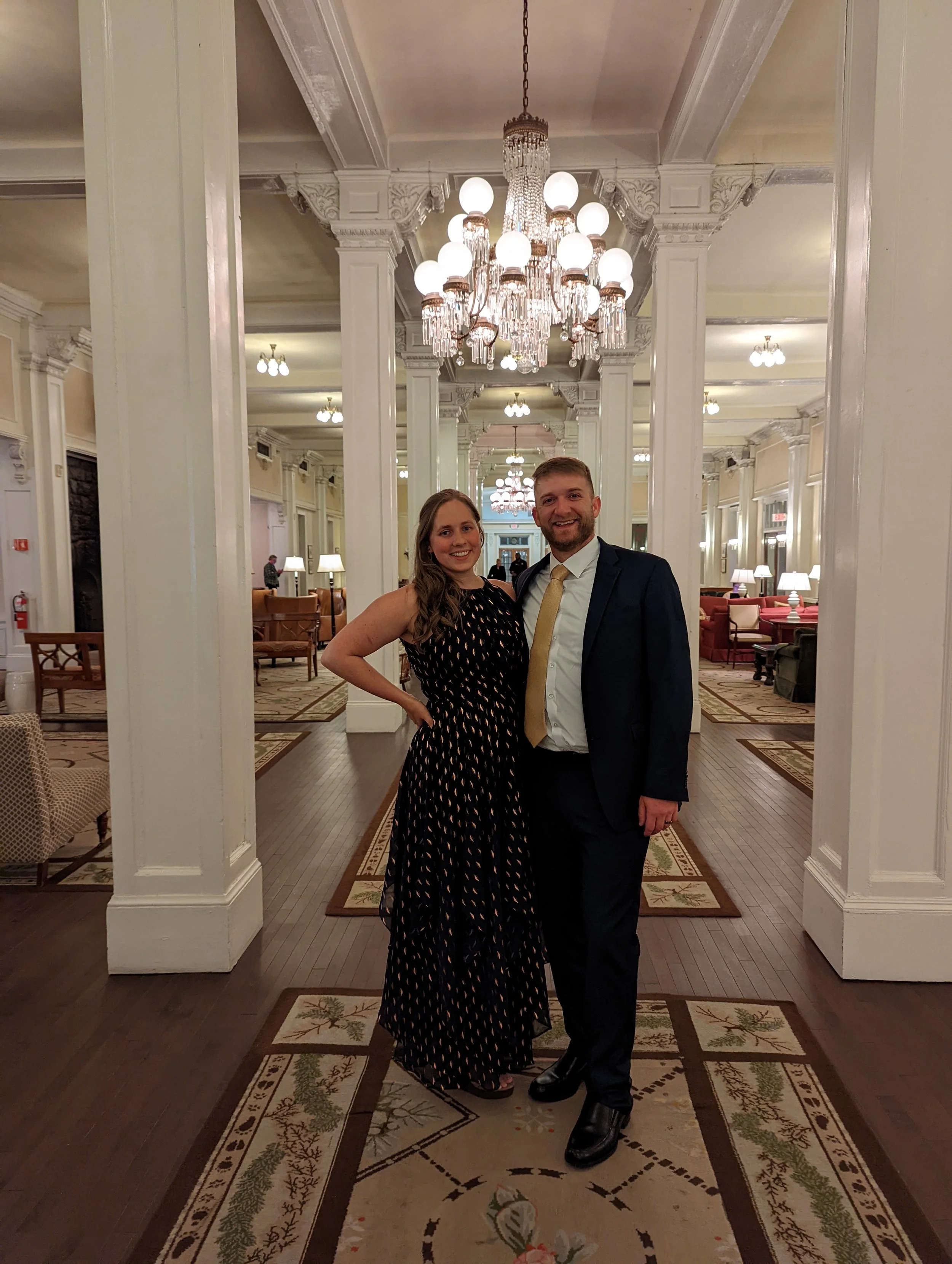
Me and Josh, one year ago, at a wedding!

Have you ever heard the term, “epizeuxis”? I first heard the word reading Mark Forsythe’s book Elements of Eloquence, which, if you’re a word nerd like me, I highly recommend reading.

Epizeuxis is a form of repetition, in which a word or phrase is repeated exactly and immediately. You may recognize, “Tiger, tiger burning bright.” That is epizeuxis. Or “Never, never, never, never, never,” from King Lear. It doesn’t have to be a single word only, however. “The horror, the horror,” from Joseph Conrad’s Heart of Darkness is also epizeuxis.

Another example, and one of my favorites, is from N.K. Jemison’s book, The Fifth Season. It says:

“But this is the way the world ends.
This is the way the world ends.
For the last time.”

If you haven’t heard of epizeuxis, though I imagine you’re familiar enough with the technique, perhaps you’ve heard of diacope. Diacope is another form of repetition; Mark Forsythe calls it a “verbal sandwich,” and the most famous example of it is, “Bond, James Bond.” Or perhaps you’re familiar with this one: “Oh Captain, my Captain.”

Similarly to epizeuxis, diacope can be a repetition of a phrase, not simply a single word. “They told me, Heraclitus, they told me” is also diacope (William Cory).

There are a couple different types of diacope besides this one: the elaborative diacope and the extended diacope. The elaborative diacope includes some kind of adjective or adverb that makes the second repetition changed in some way. If diacope is a sandwich, an elaborative diacope has mayonnaise on one slice of bread.

The most famous example of this is from “America the Beautiful” by Katharine Lee Bates: “Sea to shining sea.” The word “shining” changes the second “sea,” just a tiny bit. It’s the mayo.

An extended diacope is simply a longer one with more words in the sandwich. I like to think of it as a towering hamburger with every topping you can imagine—lettuce, tomato, onion, you name it. Take this example: “Romeo, Romeo, wherefore art thou, Romeo!” or, from our collectively favorite musical, “Alexander Hamilton, my name is Alexander Hamilton.”

And what happens when you add epizeuxis and diacope together?

You get lines like, “Repetition, repetition, sweet, sweet repetition.” Or “Alone, alone, all all alone/ Alone on a wide wide sea,” which is from “The Ryme of the Ancient Mariner” by Samuel Taylor Coleridge.

I’ve been exploring techniques like this more often lately. In my experience, they’re not often discussed in the general writing community. You see a lot of comments like, “Don’t use adverbs!” but not a lot comments like, “I included epizeuxis in my most recent WIP and loved it!”

The main criticism of using tools like this, because of course somebody is adamantly opposed to it, is that it creates “purple prose,” which according to Wikipedia is: “overly ornate prose that may disrupt a narrative flow by drawing undesirable attention to its own extravagant style of writing.” (Oct 2022)

The great thing about this definition is that it’s entirely subjective! Whether or not “overly ornate prose” may or may not “disrupt a narrative flow by drawing undesirable attention” to itself is completely, utterly, one-hundred percent subjective.

I personally find that language in prose that’s too simple and plain draws unnecessary attention to itself (I say in a very snobby way lol) just as much as overly elaborate language can. And sometimes, I like it anyway.

What we like is personal, and it’s nobody else’s right to tell us the kinds of tools and techniques we should or shouldn’t use in our writing.

For me, the most important question is: what are these types of tools good for? Certainly, they create emphasis. Impact.

And there’s the answer. Use them when you want to create emphasis. Impact.

Use them to add weight to a moment.

Epizeuxis and diacope are like neon signs that say, “Dear reader, pay attention to this moment.”

So, if you want the reader to pause for a moment in a scene or on a phrase, just repeat, repeat, repeat—the key is to repeat.

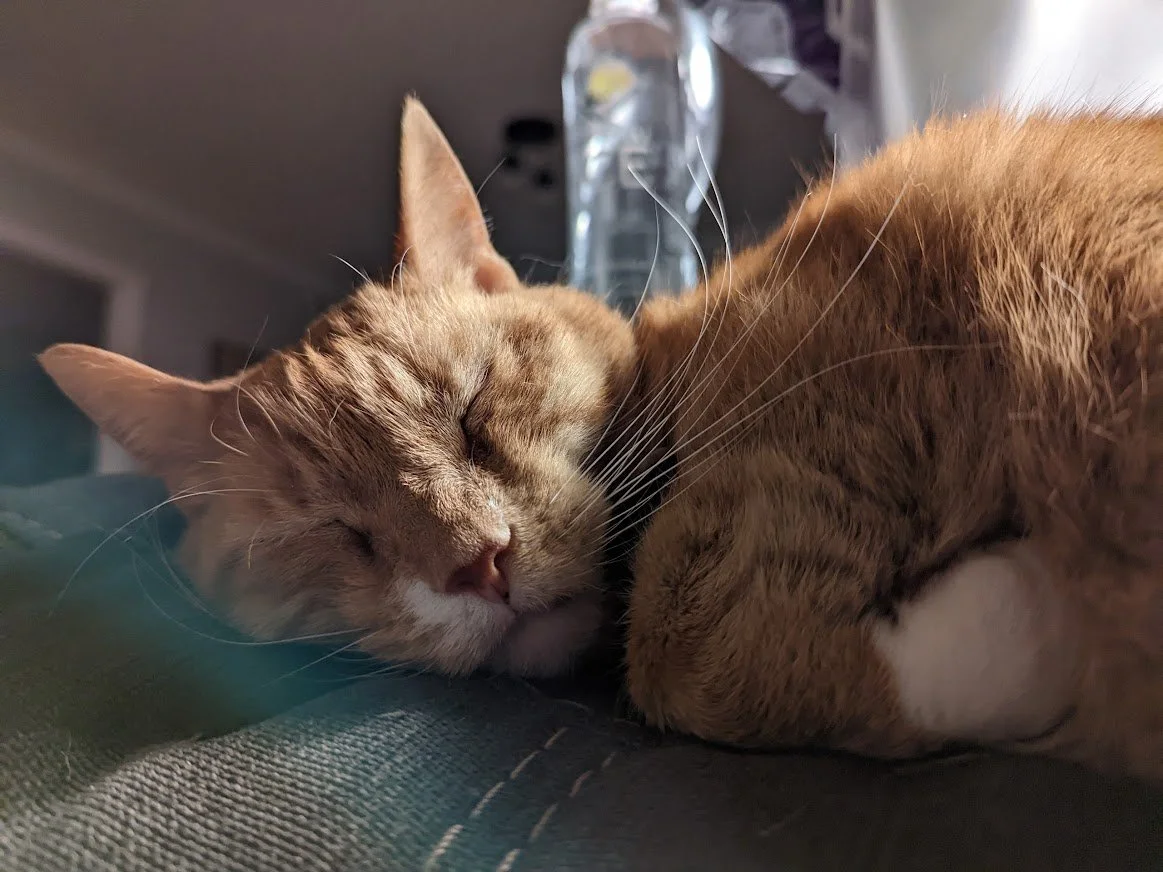
Awwww look at my sweet potato taking a nap in the sun.

Writing Tips (Sometimes): Calling Bullshit On The Rules of Writing

This is part of my series of essays for writers. Get them delivered to your inbox by signing up here!

Another throwback this month: this is me and my little brother, Evan. He’s a music producer now; doesn’t look like this anymore lol.

I recently heard someone say, “I believe the road to hell is paved with adverbs, and I will shout it from the rooftops. To put it another way, they’re like dandelions.” To be clear, it was Stephen King who said that, and he wrote it in his book On Writing, which you may have heard effusively recommended to you like it’s the modern-day writing Bible.

If you haven’t figured this out yet, I have a lot of opinions, and my opinion on this particular quote is very strong. Which is that in this particular instance, Stephen King is full of shit.

Now, because I’m a writer and a lover of nuance, I’m going to give our esteemed horror writer a break here. He continues on to say in On Writing that he does use the occasional adverb in his own work because they occasionally serve a useful purpose, but he thinks they should be avoided in most cases, and newer writers tend to use them as a crutch, which is actually what he suggests you refrain from doing.

All fair enough, I suppose. But this has not stopped the writing world from latching onto this piece of advice and shouting it from the rooftops on Mr. King’s behalf: in Facebook groups when an unwitting newbie asks oh-so-innocently, “I’m doing NaNoWrimo for the first time—what writing advice would you give me?” someone will inevitably yell, “Don’t use adverbs!”; or in a critique group, when a critiquer goes through and crosses out every single adverb; or when a new editor has made it their god-given responsibility to eliminate every use of an adverb from every manuscript that crosses their desk.

To be clear, I like dandelions and I try to spread them everywhere I go. They are good for the bees.

And if the road to hell is paved with adverbs, there’s probably good reason for it. Like the fact that hell is an extremely, terribly, ridiculously awful place to travel to.

Personally, I like adverbs. I think they are useful. And I plan on using them whenever I damn well please.

But “avoid adverbs at all costs” isn’t the only rule that is repeated incessantly within the author community. Many writers cite rules like, “show don’t tell,” “use an active voice,” “use simple vocabulary,” “keep sentences short,” “don’t use metaphors or cliches,” “write every day,” and the list goes on.

There are rules for writing, rules for publishing, rules for design, rules for distribution, rules for marketing, rules for running an author business, and rules for exactly how a writer should spend every minute of every day of their writing life. There are rules for how to interact with other authors and how to interact with readers, rules for how much your work should cost, rules for when to give something away for free, rules for how often to appear in public and exactly how you should look when you do so, and rules for what types of author photos you should use. Rules for how many people should read your work before you publish or submit, rules for the process you should follow going from rough draft to published work, and rules for exactly how many words should be in each chapter. And for how many chapters in each book. And for how much percentage of the book should be reserved for each part of the story.

(In fact, someone reading this right now probably thinks I used the word “rules” far too many times in the previous paragraph and will probably email me to say I should have written it differently.)

There’s a reason I titled this post “Calling Bullshit On The Rules of Writing.”

It’s because all the rules are bullshit.

Because I’m a lover of nuance, I will say that I think there is generally a grain of truth in most of the rules that get thrown around. There is usually a useful piece of advice to be found somewhere. Like in “Show don’t tell”—Yeah, in many cases, it makes more sense to add detail, action, description, and active voice to draw your reader into the story and create an emotional experience. But on the other hand, telling can also serve to help draw your reader into the story, by allowing the reader to have the information they need without boring them out of their minds in the meantime.

No reader needs to know every detail of how every character spends their time (ever heard of pacing? Or tension?) so sometimes saying something like, “The character was happy to skip going to the grocery store with their mom,” is a million times better than saying, “The character dashed outside to meet their friend, relishing in the sensation of happiness that flooded through them at the realization that they didn’t have to collect groceries with their mother that afternoon.” It depends on the voice, style, and tone of the piece, as well as the genre conventions and needs of the story.

The same is true of adverbs. Sometimes, it suits the story better to say, “She smiled gratefully,” as opposed to “She flashed him a grateful smile,” or “She squeezed the man’s hand, wishing she knew the perfect words to say to express the grateful feeling that filled her as a result of his kind actions.”

It depends on the story.

But my main beef with the rules of writing is not just that they lack nuance and don’t always apply.

Nope.

Mostly, I hate the rules of writing because they make it so easy to forget that writing is supposed to be fun.

Writing is art! Writing is play! Writing is an expression of emotion, an exploration of an idea, a journey, a progression, a sparkle of delight.

Writing is like cooking a bowl of soup or rolling through a field of dandelions or traversing that inexorable road to hell. It’s challenging and rewarding and terrible and exciting and beautiful. And fun.

So what if there are “too many” adverbs in a piece? What are the stakes?

Is someone going to terribly suffer from a dreadfully painful heart attack because I capriciously used one too many adverbs? Or perhaps the ghosts of Strunk & White will rise from the dead to murder me because I dared engage in the heinous crime of purple prose! Perhaps all of my ancestors will roll over in their graves from the agony of my tacky use of cliches! And if my metaphor usage is like driving a car without an engine, starting a fire with damp wood, or beating a dead horse with a stick… exactly what harm is that going to do?

There may be consequences, of course. An editor might not like it. A reader might not like it. Your mom might not like it. Your English teacher might not like it.

But the good news is that it’s your art. The only person whose opinion ultimately matters, is yours.

And if you need to make some adjustments during revisions to meet the needs of a client, a teacher, an editor, a publisher, or whomever, you can do that.

But in the meantime, just remember, the rules are bullshit and writing is fun.

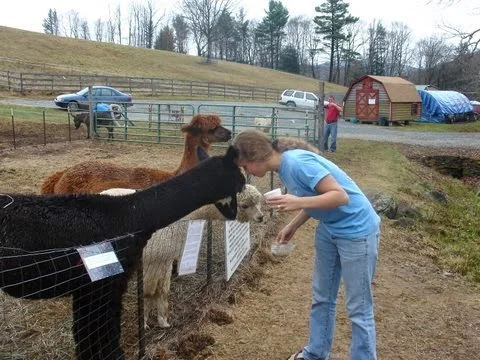
Another throwback of me and a llama. My uncle dared me a $1 to kiss it, so I did lol, and he had to pay me a dollar.

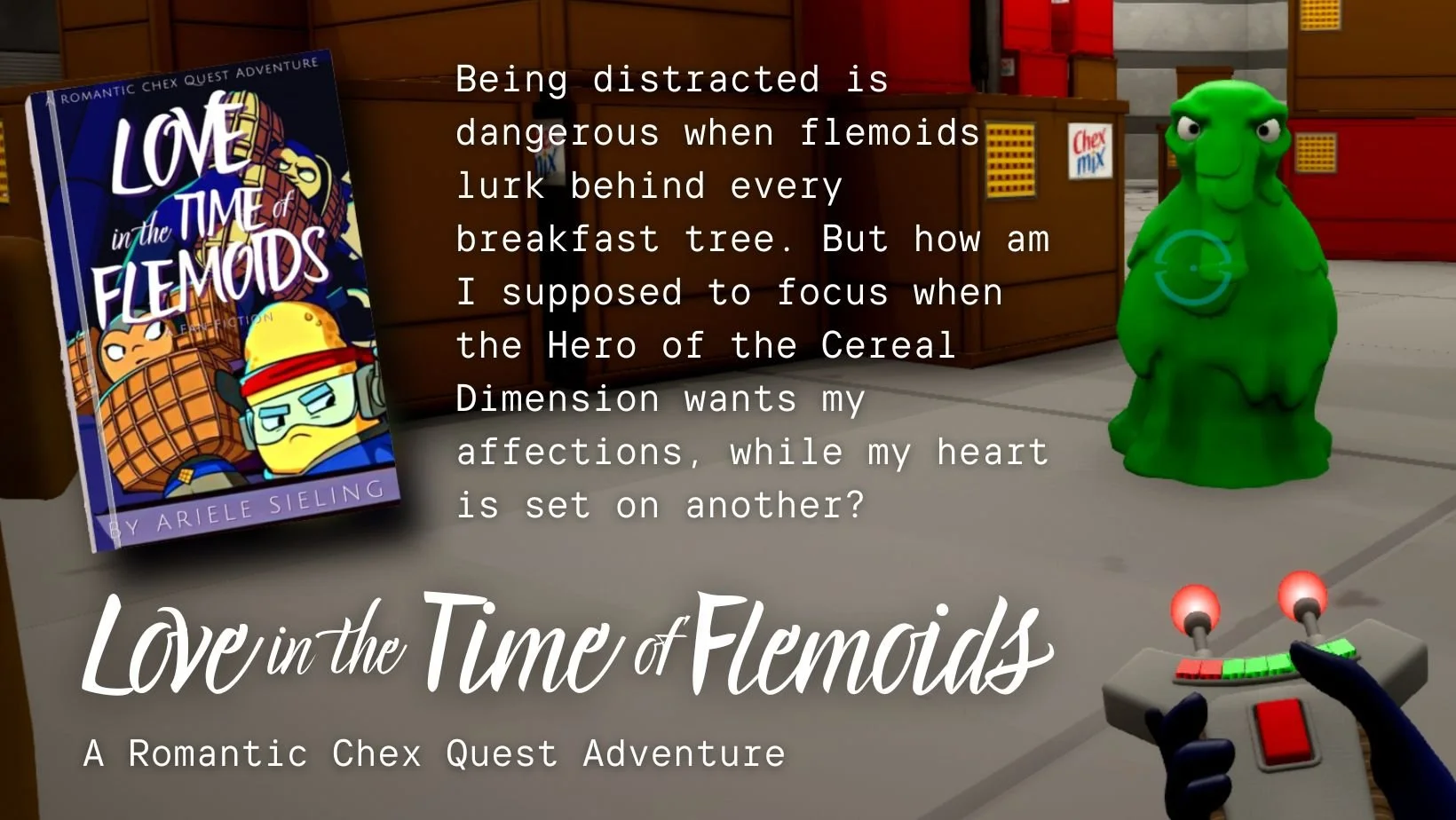
Love In The Time of Flemoids: A Romantic Chex Quest Adventure

As you probably know, I am a millennial. And I am a specific type of millennial who was born at just the right time, to be just old enough, and who happened to have lived in a household who ate cereal—to be the type of millennial whose family purchased a box of Chex cereal with a copy of the Chex Quest video game inside.

And I am the type of millennial who played said video game.

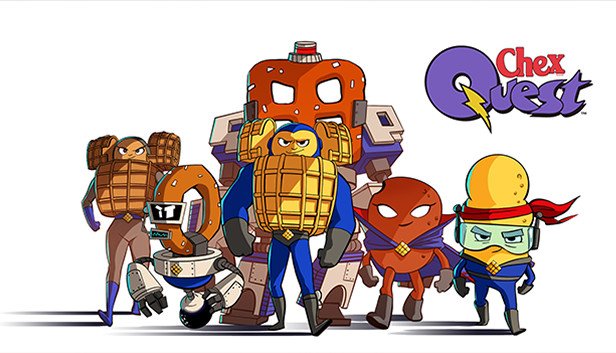
If you're not familiar with Chex Quest, it was a video game developed in 1996 based on Doom, and subsequently offered as a breakfast cereal prize in the form of a CD-ROM. Instead of bullets and guns, players used a "zorcher" to teleport slimy aliens called Flemoids back to their home dimension, ensuring the intergalactic safety of the Cereal Dimension.

Now, I also happened to be the type of kid who was only allowed to play computer games that were educational. Which meant that I played math games and strategy games, word games and typing games—but my family didn't own any "fun" games. Except Chex Quest.

Naturally, I was obsessed with it. And apparently, still am to this day.

In 2018, I had writer's block, and on a whim, downloaded Chex Quest (you can get it here for free), and had the random idea to write a romance set in the Chex Quest universe. I got about half of it written and my writer's block was cured.

Well, I had more writer's block earlier this year, so I decided to open the old project back up again.

And then I finished it.

And here we are.

Now, fan fiction is a tricky business from a copyright perspective. I own what I wrote, but General Mills owns the Chex Quest IP, so I can't publish the book the way I would normally publish it.

As such, I've made it a free reward for my Patreon subscribers, and if you'd like to read it, you find it there (click here!).

In the meantime, I’ve included a sneak peek below.

Blurb for Love In The Time of Flemoids:

Flemoids have been discovered deep within the caverns of Bazoik. Though Fred Chexster, the Chex Warrior, had supposedly zapped them all back to their original dimension years ago, new flemoids keep emerging. And it's my squadron's job to deal with them.

Even though it's my first day on Bazoik after a long interstellar trip, I'm immediately distracted by Those Eyes—belonging to the most attractive Chex scientist I've ever seen. But while my eyes may be only for Rye, somehow I seem to have captured the attentions of Fred Chexter himself.

All my missions before now have been simple: go in, zorch the flemoids, and get out. But on Bazoik, things have become far more complicated. Not only do new types of flemoids keep popping up from seemingly nowhere, but I am stuck between recieving the attentions of one Cerealian while desiring the attentions of another.

And worst of all, being distracted is dangerous when flemoids lurk behind every cereal tree. I have to regain focus, or else I risk my own life, the life of my team, and all of planet Bazoik.

Love In The Time of Flemoids: A Romantic Chex Quest Adventure

Chapter 1: Those Rye Eyes

Those eyes. Dreamy wasn't the right word. Gorgeous wasn't the right word, either. Distracting? Yeah, that was it. I pulled my attention away from the scientist on the other side of the room and refocused on my commanding officer.

"There are eighteen buildings in this compound!" my commanding officer shouted. "Memorize every one! Housing! Cafeteria! Arboretum! Meeting area! Landing dock! Laboratory—"

I zoned out again, my eyes straying back toward the scientist. He was over by the drink machine, pouring a refillable glass of orange juice. I slowly rotated the glass I’d been assigned on arrival in my fingers. These scientists and their refillable glasses. I was pretty sure I hadn't seen a disposable cup since I got here. He wore a lab coat just like the rest, and had a square, solid body type. Then he glanced over toward the group of soldiers I stood with and I accidentally caught his eyes.

"Aw toast," I swore under my breath, looking away abruptly. He had definitely seen me staring, but there wasn't anything I could do about it now.

"The flemoid nest is in the caverns below the settlement!" my commanding officer shouted. Alpen was a no-nonsense straight-shooter, who never bothered with quiet commentary and closed-door conversations. If she hated you, she said it to your face. "We will set out at 0800 tomorrow. Today, familiarize yourself with the facility, memorize the cavern maps, stop by the armory to get your zorchers recalibrated, and eat! Dismissed!"

The squadron broke apart, chatting quietly among ourselves. I carefully kept my gaze away from the scientist on the other side of the room and focused on my comrade, Crunch.

"Do they really need all of us for this?" Crunch groaned, tagging along beside me. Crunch and I usually were assigned to bunk together, and we got along well.

"It does seem like overkill," I agreed. "Where are you off to now?"

"Gonna get my zorcher recalibrated first thing." Crunch shrugged. "Who knows how long it will take?"

"Mind if I come along?" I asked.

The two of us headed back toward the armory, which was just one of the lab buildings that had been repurposed. The bulk of my other squadron members were heading toward the cafeteria, so it was mostly empty when we arrived.

"Hello there," the armory guard said as we entered. "Welcome to Bazoik!"

"Hey," I said, offering a casual wave. "We need to get our zorchers recalibrated for flemoids."

"I can do that for ya." The guard smiled. "Name's Rice, by the way."

"I’m AJ, and—" I glanced at Crunch. She was staring at Rice, unable to tear her eyes away. "Well, uh, this is my buddy Crunch." I elbowed Crunch in the ribs.

"Um, good breakfasts," Crunch said hastily, blushing. She pulled out her zorcher and handed it to the guard.

Rice winked at her. "Nice to meet you both. How was the flight?"

"Eh," I said, shrugging, reaching out to hand him my zorcher as well. "They put us in stasis this time around. We think they're trying to save money on training new warriors by making it so we never age."

"It's always the same, huh?" Rice chatted. "Always about money. Just give me two minutes—I'll be right back with your weapons."

As soon as he disappeared into the back, I nudged my friend and waggled my eyebrows in the direction Rice had disappeared.

"Knock it off," Crunch muttered, her face still red. "I was just surprised, is all."

"You think he's cute!" I pressed, grinning. "He is, it's true. You gonna ask him out?"

"Depends on how long we'll be here." Crunch’s blush deepened to an even darker shade of red.

My grin widened. Last time I had seen Crunch this discombobulated was when she had just returned from an evening run, during which she had nearly tripped over a drunken doppelgänger of the famous Chex Warrior, Hero of the Cereal Dimension, and possibly a compulsive liar—though no one was sure about that. It hadn’t been him, of course, but for at least ten minutes, she had thought it was and her face had been as red as a fire engine the entire time.

"But you're hardly one to talk," Crunch added. "I saw you staring at that cute scientist earlier." It was her turn to waggle her eyebrows at me.

"I don't know what you think you saw," I said airily, "but I can assure you I wasn't staring at anyone." She knew I was lying through my teeth, naturally.

"Whatever you say." Crunch winked at me just as Rice strolled back into the room.

"Zorchers are re-calibrated to send the flemoids back to their dimension, as requested," he said with a grin, "and I charged them up for you while I was at it."

"Thanks, Rice!" I said.

"Let me know if you need me to, ah, double check them," he replied, winking at Crunch.

She blushed furiously, and then turned and fled the building.

"Hey," I said, meeting Rice’s gaze with a grin of my own. "Can I get your number—for her?"

Rice grinned and nodded. "Sure thing, Corporal." He handed me a piece of paper. "Have a delicious day!"

"You too!" I hurried to catch up with Crunch.

"Food?" Crunch asked, as I moved up beside her.

"You want your present first?" I tilted my head and raised an eyebrow.

"What present?"

I grinned and handed Crunch the piece of paper with Rice's number on it.

"I can't believe you did that!" If possible, Crunch's face flushed to an even deeper shade of red, almost purple.

"You're welcome," I said, skipping off toward the cafeteria.

The cafeteria was an enormous room. A small kitchen staff fed ingredients into the breakfast machines, which spit out wonderful smelling combinations of eggs, bacon, fruit, milk, and bread. We had been fed intravenously during the journey, so not only were we all starving, but we were ready to experience taste again. All I’d had since arrival was juice and nutritional supplements.

"It smells amazing," Crunch exclaimed as we moved deeper into the room.

We grabbed trays and headed for the first group of machines. Pictures of bagels of all shapes and sizes covered the outside of the machine. There were fruit bagels (blueberry, strawberry, banana, and raisin), nut bagels (almond, walnut, bay-nut, and peanut), and seed (sesame, cornseed, and flax). There were also breads, toasts, english muffins, and blueberry muffins, to name a few—and I couldn’t wait to dig in.

Next up was the protein machine—ham, bacon, and beans were the three most frequently consumed proteins, but this machine also had steak, chicken, and something called desert squirrel, which I assumed was some kind of local animal they had been catching. Though, I’d thought they’d said this planet was lifeless, so perhaps it was imported from another planet in the solar system.

There were giant baskets of oranges, lemons, apples, and bananas, and fruit juice machines filled with orange, cranberry, and apple juice. They also had coffee, milk, and tea available.

The biggest machine was filled with all kinds of cereals—square, torus-shaped, spherical, flat—you name it, in all colors and with every flavor. Every single kind was my favorite.

I helped myself to a banana bagel with cream cheese, an apple muffin, four slices of bacon and a slice of desert squirrel (just to see how it tasted), a banana, a giant glass of orange juice, and two bowls of cereal—sweet and square, and fruity and spherical.

"This is incredible." Crunch’s tray was just as full as mine. "I haven't had food in so long."

"Yeah, supplements and liquid meals get really old." I bit into the blueberry muffin, closing my eyes to savor the experience.

"Welcome to Bazoik," a voice said from my left. I turned, my eyes flying open and my mouth still full of food, to see Those Eyes looking down at me.

"Fank moo," I said, blushing as I tried to swallow the mouthful of muffin.

Crunch burst out laughing. "Nice to meet you," she replied to the scientist. "Thanks! We're just glad to be on solid ground again."

I coughed a little as the rather large lump of muffin that I had neglected to chew brushed up against my windpipe.

"Name's Rye," Those Eyes said.

"I’m Crunch, and this here is AJ," Crunch.

"AJ," I said, reaching out to shake Rye's hand. I swallowed again, trying not to cough all over the man. "Nice to meet you."

"Mind if I sit?" Rye didn't wait for our response, but sat down beside me and grinned. "So, what are you two here for?"

"Clearing out the flemoid nest down under," Crunch told him. "Then no doubt we'll be on our way to some other colony on some other planet to clear out some other flemoid invasion."

"We'll have to see if we can dig up any more flemoids," Rye said, "to give ya'll a reason to stick around." He winked at me even as Crunch sent me a pointed grin.

"What do you do?" I asked, relieved that my voice sounded normal, not spitty or like I was choking.

"I'm on the HB team—er, that stands for Hot Breakfast," he said. "We're working on a genetically modified tree that can grow a complete hot breakfast on one branch. So far, we've gotten it to grow two types of cereal and orange juice, but no protein."

"Sounds interesting," I replied. I didn't know what else to say. He was so close, I could feel the heat radiating from his body. I sent Crunch a panicked look, but Crunch just grinned at me and chomped down on a slice of bacon.

Just as I was about to idiotically ask, "Do you water the trees?" Rye added, "Yeah, it's an interesting project for the most part, but the most interesting part of our month is when we get new people! Same old teams get pretty boring around here. We're a new colony after all, so it's not like we can just head over to the next town for some fun—you know what I mean?"

"What is there to do for fun around here?" I asked, relieved that I had narrowly avoided asking if he watered the trees. Talk about embarrassing. I took a sip of orange juice and tried not to look at Those Eyes. They were greyish green, with little flecks in them, and long, graceful eyelashes. And his shoulders were as broad as a soldier’s, practically ripping the seams of his lab coat.

"Weekly dances." He shrugged. "Some good bars, bowling. Some good hiking if you like desert. There's a band called Trix Me Baby that plays shows sometimes. Other than that—" He shrugged again. "It's a small colony, what can I say?"

"Rye!" a voice called from across the room. "You're late!"

"Gotta go!" He stood up and grinned down at us. "Hope to see you muffins around."

Muffins. It was a casual enough term, but in this instance… I nearly groaned as I watched him stride rapidly across the room. Then I faced Crunch, only to find her staring back at me mischievously.

"I'm going to call it The Muffin Mishap," Crunch said.

"Ugh, no please," I actually groaned this time. "So embarrassing!"

"You can be the Muffin Man if you want."

I covered my face in my hand. "Can you believe I almost—almost—asked him, 'Do you water the trees?'"

Crunch let out a peal of laughter that shook her entire body. "Do you water the trees?" She repeated breathlessly, tears of amusement glistening in her eyes. "Oh, I would've paid to see that."

I glowered at my friend. "Next time, I am going to leave you alone with the armory guy, and see how you like it. You weren't helpful at all."

Crunch wiped her eyes and took a bite of eggs. "Next time. I promise. I'll help."

I shook my head. It had been awkward, yes, but I still wanted to see Rye again. And as he said, it was a small colony—I probably would. And soon.
Learn More on Patreon