Land of Szornyek: Maps

Maps! Everybody loves maps. Now, I know I don’t have an official map for Land of Szornyek (yet!) but I do draw my own to keep everything organized in my head. I am considering putting together an “official” map (not to scale!) for the final book of the series, but please stay tuned for updates on that lunacy.

The main reason I haven’t included a map in the books before now is because of my serial pantsing (or discovery writing for you politer people than I). I didn’t want to lock myself into a map that wouldn’t end up working for a future book. And I couldn’t make a major map, because I don’t decide anything up front, so I didn’t know what types of locations would be relevant, and again, didn’t want to lock myself in.

I thought, however, it might be interesting to some of you, to see the maps I’ve been using over the past few years. It’s very helpful to at least have an idea of where everything is located and how it is organized, especially when I’m describing where the sun is in the sky, what direction the characters are walking in, and how long it takes them to get from place to place. I use rough estimates, and figure that as long as it’s close enough, that’s good enough for me.

Note: if you’re partially through the series or haven’t read any of it, the following sections may contain spoilers!

Maps for Tentacles and Teeth

This map served as the primary basis for Book 1: Tentacles and Teeth. I added a few notes so you can see better all the different locations. At the top, you’ll see Capa Lake and the L-shaped rock, which were based on a chapter that ultimately got deleted from the final manuscript. This also won’t be entirely accurate for the final map version (if I do it), but it functioned well enough for drafting a manuscript.

The other map I have for Tentacles and Teeth is of the cave where they encounter the barlang. I struggled a bit with the cave because while I’ve been in a few, I haven’t been in that many, and I wanted to create something bigger than anything I’ve experienced. So, I googled a few pictures and YouTube videos, and then just went for it. It’s fiction, after all! I can create whatever caves I want to fulfill the needs of my narrative.
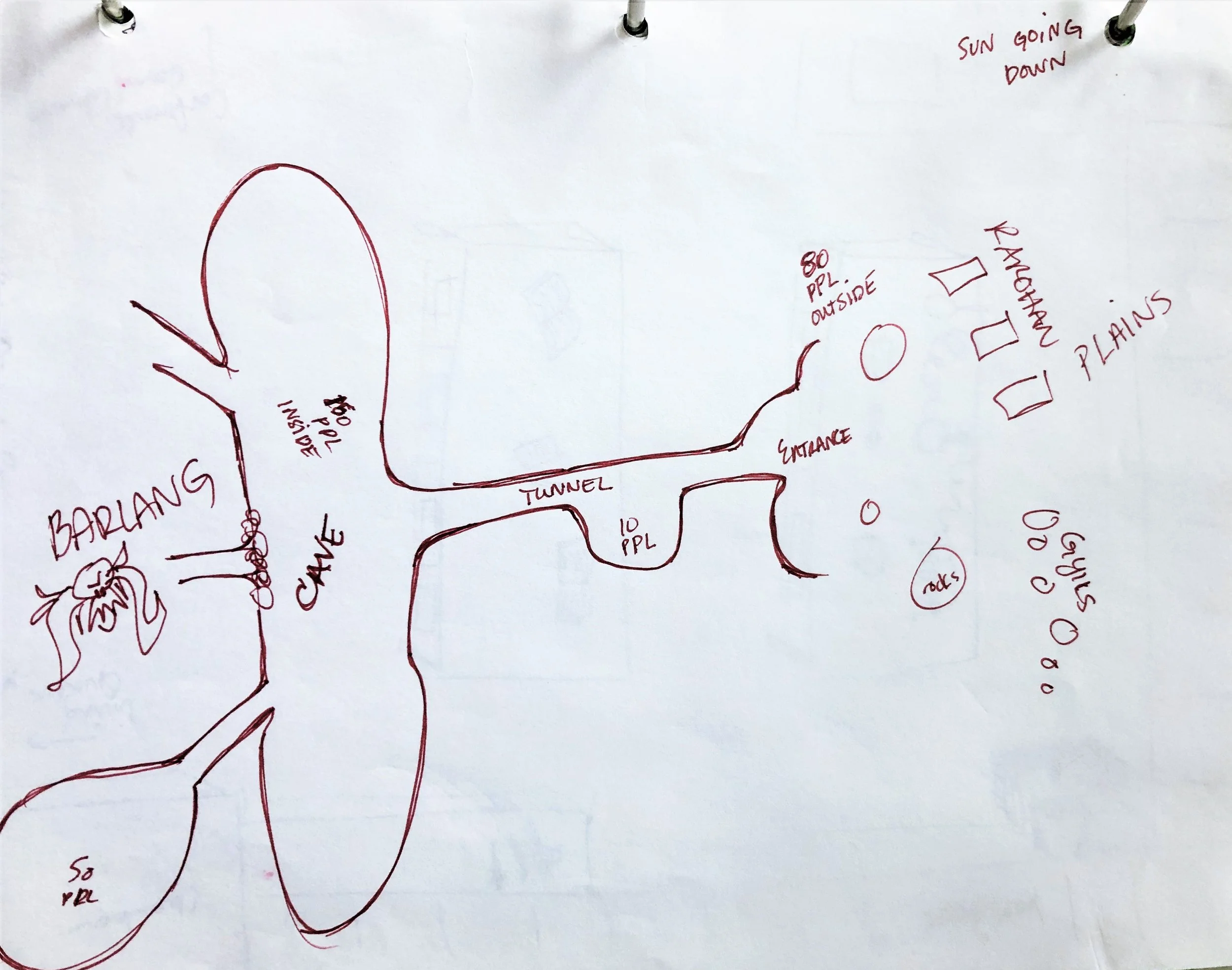
As you can see, this map also accounted for rough population numbers and the location of the other monsters during the final battle scenes. I even noted the time of day.

Fun fact: it’s easy to forget where the sun is when you’re in the middle of writing an action-packed battle. But that doesn’t stop time from moving forward, and the sun from rolling through the sky. Even in imaginary worlds (unless you’ve created an imaginary world without a sun, or a static sun, or…).

Maps for City of Dod

I made several maps for City of Dod. Because Askari has to travel relatively far away from her starting point, I struggled to keep all of the various locations straight in my head, and so I ended up drawing multiple maps to either keep myself sane or to inspire new chapters.

This first map doesn’t include the starting point of the book, which would be north, but if you look on the right side, you can see the location where they ended up camping after getting thoroughly beaten by the bogar, and almost killed by the nando.

You’ll also see some locations on this map which, again, did not make it into the final draft of the manuscript. The Underground Library (infested with a particularly awful swarm of monster bugs) was a plot point which ended up being a distraction and irrelevant, though. The Szall was a dragon-like monster that I decided was too similar to your regular mythical dragon, and Devor showing up turned out to be a much better plot arc anyway, so that became Devor’s barn. If you squint, you can see a reference to the gerinc queen—another weird monster where the queen was an exploding blob of acid. You can also see a scribbled reference to “Vadasok Camp.” Originally, the Rokkin were named Vadasok.

Fun fact: the word “Vadasok” is based on the word “vadászok” which means “hunter” in Hungarian. The word “Baratok” means “friends” in Hungarian. But I updated my naming conventions after Book 1. The Baratok might use their Hungarian-English dictionary to name everything they see, but everyone else does not. “Rokkin” is based after “the rok” and “kin” (meaning family), as in family to the great mythical Rok, bird of prey that could defeat massive creatures.

The next map is a close up of the Rokkin Camp (referred to as Vadasok on the map). Again, this is not entirely accurate—the City of Dod is south of the camp, the Bikak enounter north. In addition, Devor’s barn and the szamos field ended up being to the east of the camp. And the gerincs got d.e.l.e.t.e.d.

Also, Fane’s name used to be “Sven", so you can see his tent down there, and Rona (yes, I do regret naming her this), used to be Veleto. See? Aren’t you glad I updated my naming convention? Lol.

Also, if I were to do this again, I’d swap the water, wood, resources with the latrines—put them as far away from the dining area as possible lol.

The next couple maps are more for inspiration than anything. I was trying to put my brain inside Askari’s head—what would she be feeling? What would she be thinking?

Ultimately, the direction is off too. The dome is directly east of the city.

And in this second sketch, the arrow indicates the direction the Rokkin entered the city from, evading the Field of Screams.

Lamplighters Society Maps

My main focus for the Lamplighters Society was inside Greystone City, so I don’t even have a map that shows everything. All I really needed to know was that Ardilla Woods and Gota Field were south-ish, and Orange City was north-ish.

Inside, however, it was really important for me to keep everything straight.

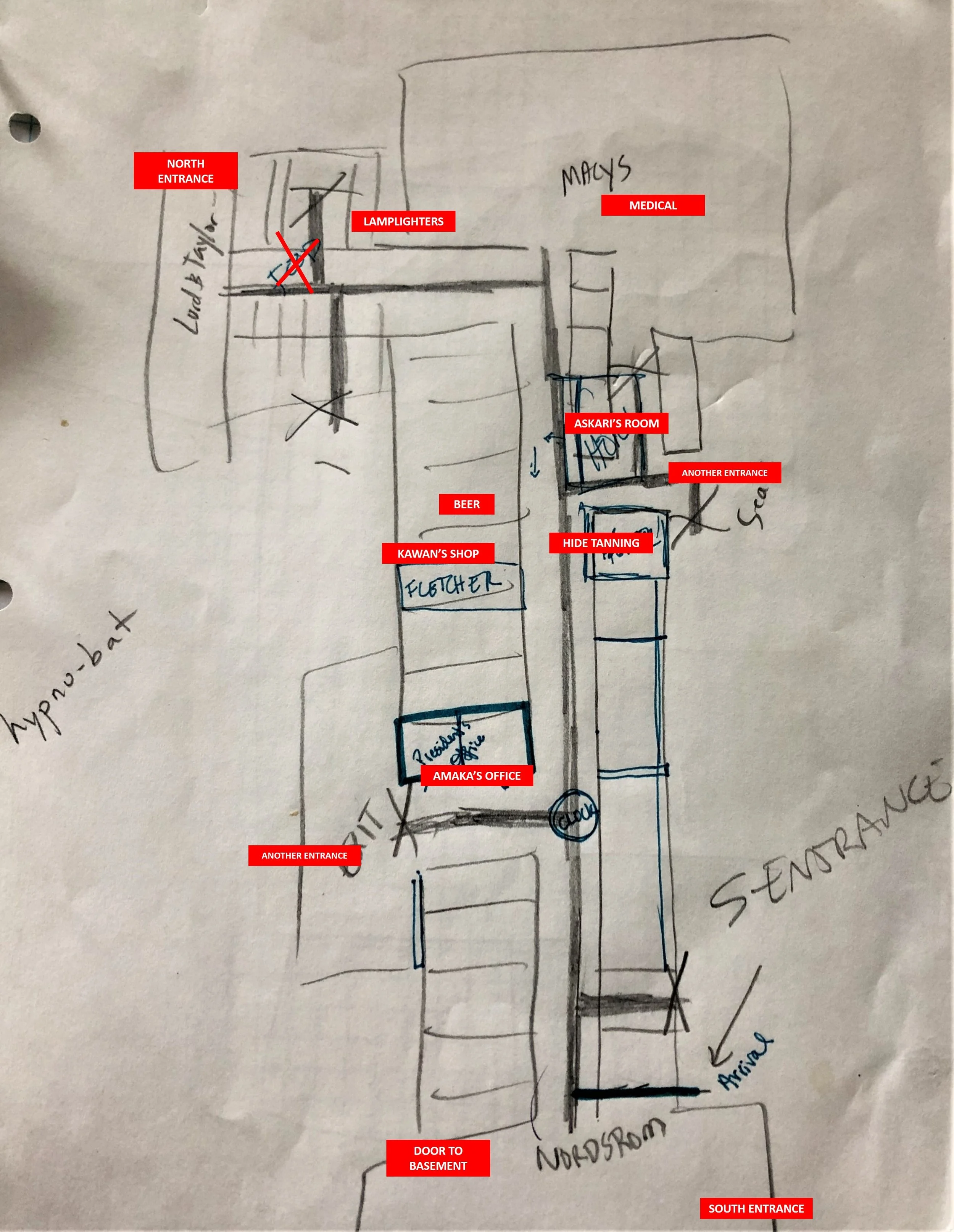
I used a map of a real mall and taped together features of other malls I’ve been in to create a fake, but hopefully realistic-feeling mall. I started with Northshore in Boston, but wanted it much, much smaller than that, so I tried Fox Run in Newington, NH, but that was too small, so I did a bunch of Googling and hacked together my own.

As with the other maps, this is not entirely accurate, and I’ve added a few details that are not included in this original images, such as multiple entrances, where medical is located, Askari’s room, etc. The drawing for this mall also makes it look much narrower than it truly is, but there’s a lot of room inside that you can’t see. And I didn’t include a food court on this map, but that’s where the food would be—not at the end of some random hallway outside Lord&Taylor lol.

Also, please don’t ask me why I wrote “hypno-bat” on the edge. It was probably an idea for a monster that never became anything, but I don’t really like the idea of imagining a “hypno-bat” and what it might want from me (blood, probably lol).
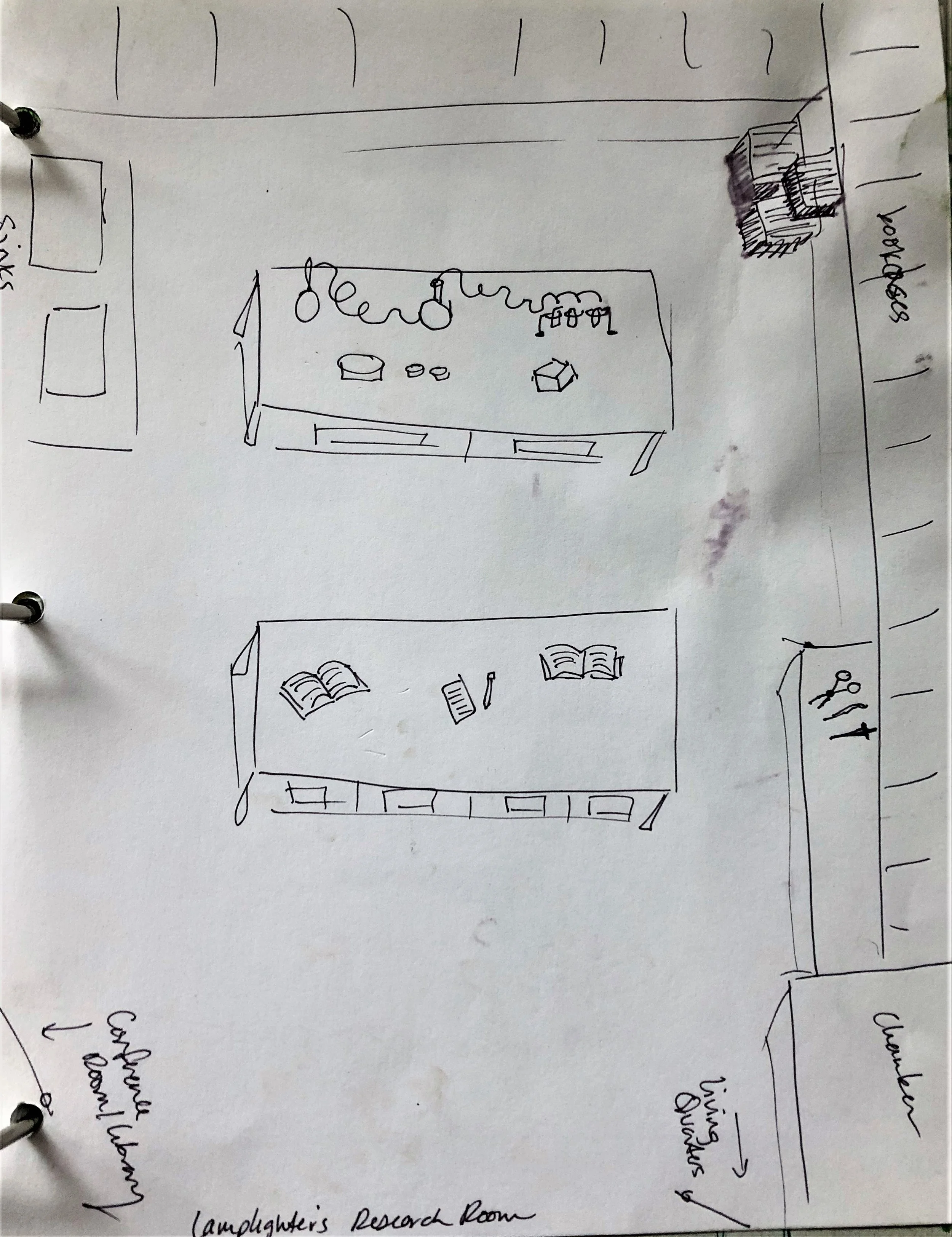
Next up is a real quick sketch of Hank’s laboratory room. Not included is the front room with the big table and chairs. I mostly used this for marking out the blocking, and even used random items I had around my office as characters (a small Lego figurine of a weeping angel, a cat figurine, and a roll of stamps—Hank was the weeping angel, obviously, Askari the cat, and Lilith, the stamps lol).
The last map I’m going to show is actually a map of the US, which you’re probably already familiar with, but I made it when I was plotting out all the locations of all the portals. Again, it’s not entirely accurate (there are portals all over the world, not just in the US), but it was helpful for ideating.

Maps for Vault of Bones

I only have one map for Vault of Bones and it’s inside the Vault. I have included the Marketplace and the Lake on future maps, but I can’t show those to you yet, because of spoilers for books 6 & 7.

I researched actual prepper bunkers for this map, and again, hacked together something I thought would work for the story, rather than using one specific design. The one difference here is that the map mentions a second hatch. I’m not actually sure there is any reference to that in the book, and I can’t remember if I took it out, or actually indicated that there was no second exit hatch. Either way, this map is probably the closest to what actually happened in the book out of all the maps in this post.

Voro’s Return Map

I had to examine this map closely before posting, to make sure it didn’t include any spoilers for Book 6, lol. Turns out, it DOES.

However, it’s still super useful for understand where things are in relation to each other. So I’m including it anyway. Don’t get too spoiled. I also included a few references to things that happened in previous books, so you can see how they’re related as well.

Anyway, that’s all for today! I hope you enjoyed my map-making adventure.

I do plan on having an “official” map at some point. Hopefully, I’ll be able to have it ready before the launch of the final book.

In the meantime, happy reading, and watch out for monsters!

If you’d like regular updates on my work, click here to sign up for my newsletter!

And if you’d like to support my work financially, please consider signing up to become a patron.

Land of Szornyek: Who Are The Lamplighters? (possible spoilers)

It’s a new year, and the Land of Szornyek series is coming to a close. I know for my readers there’s a bit of time left, as I still have two books left to publish, but for me, with both of the final books in the series full drafted and in major revisions, it’s starting to feel really different.

The beginning of the year often has me reflective and contemplative as well—about the past, where I’ve been and how I got to where I am, what I’ve learned along the way.

The Land of Szornyek series was a series of immense growth for me. My writing from beginning to end improved considerably, my understanding of story structure, setting, characterization, pacing, and all the wide variety of elements of story also significantly increased.

I’ve become more efficient in the craft, first of all, but I’ve also really started to pinpoint the process which works best for me. And by “best,” I mean both: the process that is easiest for me to traverse from initiation to completion, as well as the process that allows me to produce the best stories I am capable of in that moment.

I took a lot of notes for Land of Szornyek. I wrote down a lot things. Brainstormed characterization, plot arcs, monster traits, motivations, politics, world features (just to name a few), especially early on in the process. And as we move into this new year, I’d like to share some of the bits and bobbles with you, as well as thank you for supporting me on this journey.

Please bear in mind that if you have not read the series or are only partially through, there may be spoilers in the section below.

Who Are The Lamplighters?

This first detail I pulled out of my archive was this piece of lined paper (college-ruled, if you were wondering), in which I had drafted my first ideas for who the Lamplighters were. I did this all the way back in Book 1, though readers didn’t fully understand who the Lamplighters were until Book 3.

I’m going to type out what it says, and post the photos of the original source. I’m going to fix typos too, because I can’t help myself lol.

Who Are The Lamplighters?

Started as a social club for professional and amateur scientists. They had weekly/monthly meetings, networked, cocktail parties, etc.

Then they began to separate into groups—biologists, physicists, etc. which began to defeat the whole purpose of the organization anyway—they were supposed to interact to learn what their own disciplines might be lacking.

So, the great grandson of the founder had an idea: create a project that needed everyone to work on it. So he proposed they look for dimensional rifts and find out what was in other dimensions.

Everyone was game.

Turns out, the rifts weren’t so hard to find. The meteorologists pointed out pockets of weird weather phenomenon which corresponded with the paleontologists’ and meteorologists’ findings of strange phenomenon in their areas of study. Physicists jumped on board and began studying the fluctuations in gravitational pull and magnetic poles—then the engineers and inventors joined and began to look for a way to great a gate. They managed a window and saw, to their surprise, animals! Biologists joined. Everyone was studying it together.

Then there was another rift in the organization.

Some wanted to make doors and open the gates. Others wanted to wait, study.

The first group won.

The second group predicted the end of things.

They were right. They built homes, prepped, so to speak. They set up systems, resources, stockpiled. It wasn’t enough.

Then the end came, fast and furious. Those who opened the gate were dead. Everyone else was running for their lives.

A Couple Thoughts

I’m a serial pantser and/or discovery writer, if you prefer the more polite term, so most of what happened in the books I didn’t know until after I’d written it. Which means, I learned a few things after this, though, this provided the foundation for everything and I would say is still accurate… from a human perspective. The monsters would tell a very different story, if they had been the ones to write this.

Stay tuned for more monster-themed posts <3

If you want to stay updated on my book launches, click here to sign up for my newsletter!

In addition, if you would like to continue to support me on my journey, please consider signing up to become a patron. Click the button for more details.

Ariele University: My Thesis Project

Hello, and welcome to Ariele University. If you haven’t heard of it, it’s because I made it up. You can read all about it by clicking here. Long story short, I wanted more education in writing, publishing, and marketing, but I didn’t want to pay a bajillion dollars to a university to get it. So I invented my own Fake Master’s Degree program, and named my university after myself.

Since mid-2018, I have been reading books on writing, marketing, business, and publishing, as well as have a pretty solid selection of fiction in quite a few genres. I have also written essays, done writing exercises, and tried to blend the things I’m learning into my works in progress, my marketing, and my business plan. I also started a Discord server of writers, who, possibly unbeknownst to them, serve as my “classmates,” and engage in discussions on the aforementioned topics on a regular basis. I’ve also taken quite a few workshops, over the last few years, ranging from Joanna Penn’s courses, to the Crash Courses with Hank Green, to workshops at conferences and writing groups in the region where I live.

You can see my curriculum, conveniently organized into a Google spreadsheet, here.

Last year, I promoted myself to teaching assistant + grad student, and started preparing courses and books on writing and marketing, and I have been teaching in-person and digital workshops right along.

The only thing I was missing was … a thesis.

So today, I am going to introduce my thesis to you.

I considered a lot of things—creating a series of courses on writing, a podcast, an art project. But I wanted whatever my thesis was to incorporate as much of what I’ve learned over the past several years as possible. I needed to demonstrate what I’ve learned.

Hence, it quickly became clear that I needed to write a book as my thesis.

But the thing is, writing books is my full time job, so I needed it to be something slightly different than my typical monster book or fairy tale. It had to be something new, it had to challenge me in its themes and style, as well as in the production and marketing of the book.

So, please welcome my newest trilogy: Aria’s Song. (Disclaimer: it is not published yet, so I reserve the right to change absolutely anything about it, including the title and or series name.)

My thesis is this: write a new series in a new genre, do something new with the design and production of the books, and do something new with the marketing.

The trilogy is now fully drafted, has been beta read, and is in final edits. It is a fantasy series (so far I’ve only written sci-fi!), and to challenge myself with the design, I am developing a world map myself and doing the cover design for the series. I will, however, continue to hire my proofreader and book designer, to ensure the quality of the final product. To challenge myself on the distribution and marketing side of things, I have also decided to attempt what I’m referring to as a “Netflix-style series drop,” where all three of the books will be available for sale at the same time, and my goal is to have everything completed by summer of 2022.

Once the book is launched (and assuming I finish all my other assignments [note: I will]), I will consider myself graduated from Ariele University with a Fake Master’s Degree in Writing and Indie Publishing.

The series is set in a futuristic sci-fi world with androids, hovercars, and skyrises. Magic used to exist, but the final king (before they switched to democracy) instituted a purge of all magical people, and as a result, magic has long-since died out. Civil unrest ravages the world, the conflict between those whose ancestors could do magic and those who hate magic in all its forms.

The story follows a young woman named Lenna, whose entire life has been plagued by the sudden appearance of a mysterious train. For as long as she can remember, anytime something bad was about to happen to her, a mysterious train would swallow her up and drop her off somewhere else—somewhere safe. On one hand, this was good, as it served as a form of protection from anything significantly traumatic that could have happened to her. On the other hand, it makes it impossible for her to build a life with friends, a job, or any kind of stability whatsoever. And in fact, she finds it difficult to even think about the train, no matter how hard she tries, which makes it nearly impossible for her to sort out exactly what is happening to her.

She doesn’t know what the train is, why it comes, or what happened to her family. All she knows are three things: 1. She has to find her mother, 2. All computerized things die when they come too close to her, and 3. She should never speak of the train.

The story begins when the strangeness of her existence is about to be uncovered by a man hunting for an android murderer. She must decide whether to help him or to run from him, and discovers quite suddenly that there are dangers in this world that not even her train can protect her from forever.

So far, I have done three separate cover designs, though I have yet to decide which one I am going to use, or if I’m going to design a new one entirely. I am far from an expert in cover design, but I think these all turned out reasonably well, though with slightly different vibes. In addition, I keep reminding myself that I can always hire a designer to do a second design, if whatever I choose ends up selling poorly.

On the writing level, I have worked really hard on this series to weave in diverse characters, complex themes, and elegant language. I wrote it in first person, as well; normally, I stick to third person.

For example, here is a brief snippet of a scenic description from the third book in the series that I particularly like:

I let my eyes drift across the scene below. I loved how the different color greens of the trees blended together, with browns and greys mixed in, creating a multi-layered texture that coated the entire scene before us. Vibrant flashes of other colors peeked through too—a hill of bright-yellow flowers; a hedge of brilliant red-leafed trees; the bridal-white blooms of flowering bushes turning their faces toward the warm setting sun.

All the night creatures would start slinking out of their dens soon. And somewhere, not too deep in the woods, I heard the twitter of a bird, then the howl of a wolf. The hoot of an owl. The lonely aching cry of a loon. And then, the first peeper—and another and another and another—until all the frogs were harmonizing in their unmistakable, reliable clamor.

And underneath the sounds of the animals, I thought I heard something else: the wind, maybe, bending a branch that now rubbed against another branch; the trickle of water—a stream, flowing downhill to feed the roots of the trees and the plants, and to give the raccoons someplace to wash their hands... but no, it was something else, something deeper—a silky, delicate susurration; a feathery whisper; a gentle, rippling croon like a mother humming her child to sleep or the tranquil thrum of barely audible strings.

The last thing I will be doing is hiding secret messages in the manuscript. That probably sounds ridiculous, lol, but I wanted to challenge myself. And some readers love little secrets hidden inside their stories.

So there you have it. My thesis project.

I will share a couple more updates as I make progress, but stay tuned for the release of my new fantasy trilogy, Aria’s Song, and my graduation from Ariele University.

Happy New Year!

For Writers: List of Monster Parts

Click here if you’d like to join my newsletter for writers!

Having just finished up drafting the 7th and final book in my Land of Szornyek series, I thought I would share one of the more useful tools I developed over the few years: a list of monster parts.

I had the idea when I was working on the last blog post about writing monsters. I often use random lists I find on the internet to help me ideate, and this list is one I developed over four years and seven books.

Coming up with monstrous features, especially when you have to create a lot of creatures, can be difficult. So here are a few categories of monster traits I made up, populated with examples of those traits. I’m no scientist, though, so if you want to get really far into the weeds, go look up classification systems for new species discoveries.

I also surfed images of deep-sea creatures, monster art people shared freely online, dinosaurs, aliens, microscopic bugs, weird plants, and classic monsters for ideas for monstery bits.

Once I developed the list, I sometimes used it like a grab bag puzzle: “Okay, let’s take some… tentacles, poison, and a flytrap mouth, then make it enormous!” And then I would ask myself: What does it eat? How does it defend itself? Is it aggressive? When does it attack? What can my characters do to piss it off?

And voila, monster!

(Okay, in real life, I put a lot more effort into it than that, lol, but often times started here and worked outwards .)

Without further ado, the list! And, to be super helpful, I included a gallery of monster sketches I’ve done over the past few years.

Monster Body Parts

  • Tentacles

  • Face tentacles

  • Too many tentacles

  • Claws

  • Big teeth

  • Too many teeth

  • Multiple rows of teeth

  • Teeth in weird places

  • Too many eyeballs

  • Too big or small eyeballs

  • Eyeballs in weird places

  • Only one eye

  • Glowing eyes

  • Wings

  • Spikes

  • Horns

  • Tail

  • Too many tails

  • Too many heads

  • Snake body

  • Gelatinous blob body

  • Tusks

  • Visible bones

  • Hooks

  • Beak

  • Spines

  • Antennae

  • Scales or other armor

  • Too many arms

  • Too long arms

  • Human-like hands

  • Hands in weird places

  • Snout

  • Suction cups

  • Spiky ball tail

  • Too many legs

  • Really long legs

  • Really short legs

  • Human face

  • Quills

  • Quills that shoot out

  • Knuckle knives

  • Flytrap mouth

  • Scorpion tail

  • Pincers

  • Hair or fur

  • Too smooth / no hair or fur or any skin texture

  • No ears

  • Weird toes

  • Metal exoskeleton

  • Mushroom hat

  • Fire for skin

  • Uncomfortably muscular

  • Feathers

  • Metal feathers

  • Webbing

  • Long neck

  • Pustules

  • Hard shell

  • Thorns

  • Skin frill

  • Unusual skin texture

  • Weird tongue

  • Odd colors

Monster Characteristics

  • Slimy

  • Invisible

  • Enormous

  • Skeletal

  • Tiny or teeny tiny

  • Mid-sized (when it shouldn’t be)

  • Ghostly

  • Smelly

  • Grotesque

  • Super fast

  • Heightened senses of hearing, smell, taste, vision, etc.

  • Floating

  • Tall

  • Flat

  • Flexible

  • Slithery

  • Duplicate

  • One big one and lots of little ones

  • Wriggle

  • Bulbous

  • Slug-like

  • Creepy

  • Blob-like

  • Translucent

  • Rigid

  • Too soft

  • Spidery

  • Skittery

  • Aggressive

  • Able to go places humans can

  • Able to go places humans think are secure

  • Gluttonous or voracious

  • Thief

  • Clammy

  • Sweaty

  • Burning

  • Sanguinary

  • Nauseating

  • Annoying

Things Monsters Can Do

  • Flying

  • Climbing

  • Hiding

  • Poison

  • Venom

  • Neurotoxins

  • Hypnosis

  • Disappear

  • Blood-sucking

  • Strangle

  • Constrict

  • Shapeshift

  • Crawl inside you

  • Erupt from the ground or another thing

  • Disguise itself/camouflage

  • Possess you

  • Consume you

  • Take your mind

  • Scream or make weird or loud noises

  • Make no noise

  • Be difficult or impossible to detect with certain or all senses

  • Spray (ink or poison or acid, for example)

  • Detach its parts from one another

  • Disappear and reappear

  • Dig

  • Jump or hop

  • Swim

  • Sense things humans can’t

  • Hear thoughts

  • Make slime

  • Scratch

  • Suck

  • Morph into something else

  • Mimic

  • Desecrate corpses

  • Violate any basic human moral code

  • Consume things humans need (like air, water, blood, etc.)

  • Use innocuous things as weapons

  • Crawly

  • Explode

  • Suddenly change in size

  • Seem harmless, but then suddenly become not at all harmless

  • Slowly encroach

I could probably come up with a thousand more descriptors, but hopefully, if you’re brainstorming, this will help you figure out what direction you want to go. Below, I’ve included a few monster sketches I did based off of the above lists, so you can see how my Dr. Frankenstein-esque method of hacking together monsters from random parts turns out.

Anyway, happy writing!

Click here if you’d like to join my newsletter for writers!

Ariele University: Writing Monsters

For regular writing tips, sign up for my newsletter for writers :)

Today I finished up the next book in my fake university program TBR list, called Writing Monsters by Philip Athans. It had some super useful info in it, particularly if you’ve never written monsters before. He also provides significant detail in regards to ideating monsters, world-building, and the actual writing process. In addition, he provides a lot of examples from pop culture and classic literature, so it’s easy to understand exactly what he’s talking about. I would definitely say the book is geared toward beginner writers, or at least, writers who haven’t done much of their own monster ideation before.

For this essay, however, I want to talk about my own thoughts on crafting monsters. I have an entire series on it, after all: Land of Szornyek.

When I first envisioned the Land of Szornyek world, it was from the perspective of a sort of “monster of the week” episodic story structure. I wanted each chapter to feature a new, different, yet equally terrifying monster, and force my character to face off with them over and over and over again.

But the thing is, coming up with monster after monster after monster is hard. I kept a list of “monster features” which included things like: tentacles, too many eyeballs, claws, lizard skin, slime, fluids, aggression, poison, spines, etc. I drew pictures to help keep my imagery straight. I googled artist renditions of their own made-up monsters, and sifted through old-school monster behaviors like zombies (eating brains), vampires (sucking blood), or werewolves (shapeshifting).

I used elements of plot and characterization to invent monsters, asking questions like:

  • Where is my character and where does she need to go, and what can prevent her from getting there?

  • What is my character most afraid of and what kind of monster could manifest that fear?

  • What are my character’s weaknesses and how could a monster exploit those?

  • What is my character trying to achieve, and what is the most difficult possible route she could take towards that goal?

  • What does my character believe is true, and what type of monster could prove that is false?

  • What does my character want to believe, and what kind of monster could disrupt that?

And, when it came right down to it, I used the good, old fashioned delete button a lot. Too boring? Delete. Too cliché? Delete. Too easy? Delete. Too impossible? Delete.

I think monsters offer an interesting tool for writers to expose their readers’ sense of fear, excitement, dread, despair, and disgust. There are a lot of reasons why we don’t want to do certain things in life, or why we might refuse to go near something or someone.

Fear is the most obvious—arachnophobia, claustrophobia, hemophobia, and of course my favorite, hippopotomonstrosesquipedaliophobia (fear of long words lol).

But monsters don’t always have to be about fear. Monsters can be about adrenaline rushes and excitement, too. We know our character is going to win, but how will they do it, and what will they have to lose in order to survive?

Monsters can be about dread—it’s less about the monster itself, but the reluctance to face our own fears.

Monsters can be about despair—that feeling that all is lost, that there is no hope. And depending on the story, sometimes hope will prevail, but sometimes despair will win out. Even if the character survives the encounter, if they lose too much, if the cost is too great, then we can feel true despair.

Monsters can also be about disgust. We live our lives feeling disgusted—dirt, mold, dirty diapers, excrement, rotten food, people we don’t like, politics, alternative morality and ethics. Even our internal biases are often based around disgust toward people who we don’t understand, who are different than us. Monsters can harness this feeling of disgust as well. Just imagine this word: pustules. There you go—disgust lol.

Experiencing emotions through fiction is one of the easiest ways to practice feeling feelings.

Practice feeling feelings? you ask. Yes. If you practice feeling feelings, you can interrogate them in a safe space, better learn why you have those feelings, and teach yourself to respond to them.

Practice feeling feelings.

While romance can help us practice feel fun feelings like love and desire and arousal, monsters can help us practice difficult feelings, like fear, anger, dread, and disgust.

And that is why they’re so fricking great.

For regular writing tips, sign up for my writing-specific newsletter!