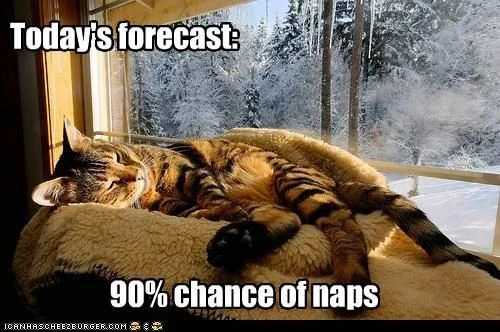
10 Pieces of Furniture Every Writer Needs

Far be it for me to dictate what every writer needs, but I think when you see this list, you will agree. There are just some things you can't live without. For some people, it's coffee. For others, it's chocolate. But for writers, it's these amazing pieces of furniture.

1. Lamp

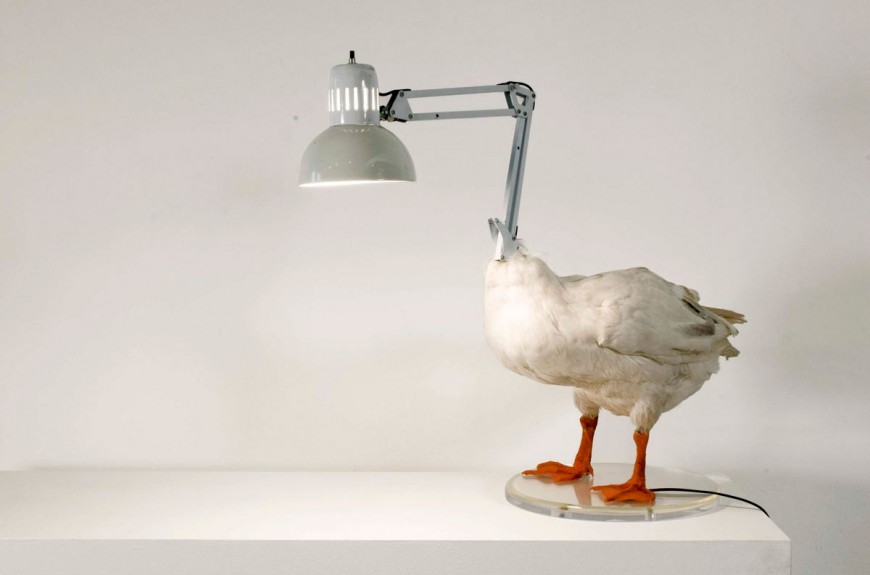
The best place to start is with this duck lamp. Everyone needs this duck lamp. Not only does it provide light and act as a conversation starter, it also serves to stimulate the imagination. I mean, think about it... an alien race with avian roots with light bulbs instead of faces that are biologically programmed to be solar powered...

This duck lamp would look great on your desk, in your living room, or out front in your lawn.
2. Chair

One of the most crucial parts of being a writer is comfort. In order to be a successful writer, you must have someplace to sit that you can trust and count on. This sheep chair is the perfect chair: soft, fuzzy, and it will keep away anyone who is trying to distract you from writing. It can also help you brainstorm characterization. The sheep on the left is Character 1 and is moody, intelligent, and remorseful...

This chair will look great in your office, at your dining room table, or on your porch.

3. Desk

As a writer, you will spend copious amounts of time sitting at a desk. As a result, you will need to have the right desk to inspire your creativity. I think rhinoceroses are incredibly inspiring, so this one should do it. It even has drawers to put little pieces of paper with ideas written on them, small stones you have collected, or feathers from local birds. Some of the ideas you could come up with while sitting at this desk include new types of technology, a scheme for smuggled rhino horns, or the intestinal system of an alien bug...

Most people put desks in their office but if you want to switch things up, this particular desk would look amazing in a bedroom, in a bathroom, or in the yard where it can freak out passersby.  

4. Bed

Everyone needs to sleep, but why not sleep while also practicing high speed car chases? I mean, look at this bed. It's cool, it's fun, and it's the perfect bed to help you brainstorm and construct scenes that take place in cars. All you need to do is install some flashing lights or some speakers for siren sound effects and you'll have everything you need for a chase.

Most people put beds in their bedroom. Other interesting rooms for bed placement include the attic, the basement, and the living room.

5. Couch

It's common knowledge that writers need to read, and a comfortable couch is a good way to go. This one, in particular, is awesome for reading outside. Just sit back, open your book, and enjoy the afternoon. It's also a fantastic way to brainstorm how people in other societies live--maybe they take all their furniture outdoors and going "indoors" is a treat!

This couch would look best in the front yard, in the living room, or in the attic, but needs to be trimmed every few days.

6. Dresser

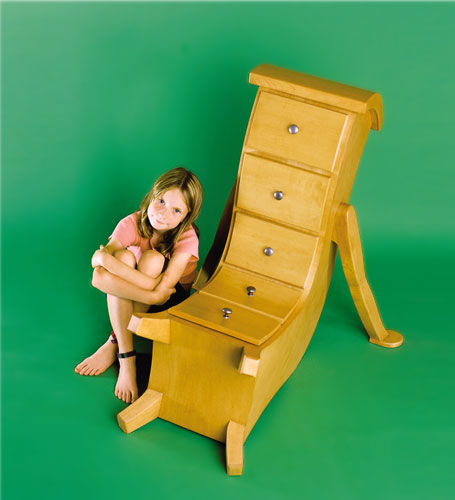
Clothes. Everybody wears 'em. If you're going to wear'em, you need to store'em. Thus, I suggest this dresser, which is not only the ultimate storage location for clothes, but also a best friend. I mean, look at it: instead of sitting alone in the house all day, writing, you can talk to this cheerful friend? Who better than this dresser? A good friend, a good set of drawers, and someone so that you don't have to talk to yourself. Then people won't think you're going crazy when you start brainstorming your new idea for a organic helicopter out loud.

This dresser would not only look great in a bedroom or closet, but also in a living room or in your office--so you don't have to head anywhere else for a chat.
7. Bookcase

They say if you're having writers block, you should kill of a character. There is no better reminder of this than a bookcase shaped like a coffin. You can even organize your books by how many characters die in them--George R. R. Martin's series would be right at the top. So while you're working, all you need to do is glance up and suddenly ideas for your main character's demise will begin rushing through your brain.

A classy bookcase like this would look spectacular in  your living room, bedroom, or office. 

8. Clock

Ugh, clocks are the worst. They either run too slowly or run too quickly, with either way too much time or not enough. Unfortunately, we need them to tell us when we are and aren't being productive. This clock in particular offers one excellent benefit, however: it reminds us of how hungry we are when we're trying to work. It says, "You need breakfast" at all times of day or night. What more could you want from a clock?

This clock would look excellent in an office, living room, or anywhere else you spend time working. 

9. Artwork

There's nothing worse for creativity than sitting in a boring room with empty walls. Good artwork is critical to the creative process. This particular piece of art is an awesome choice for acceptable wall art. This octopus tentacle will inspire you to accurately describe the monsters swimming in an alien ocean, the magic of the suckers on Octopus legs, and the personality of an odd-tempered Welshman.

This beautiful sculpture would look amazing on any wall in the house--particularly the bathroom, to startle unsuspecting guests.
10. Cat Hangers

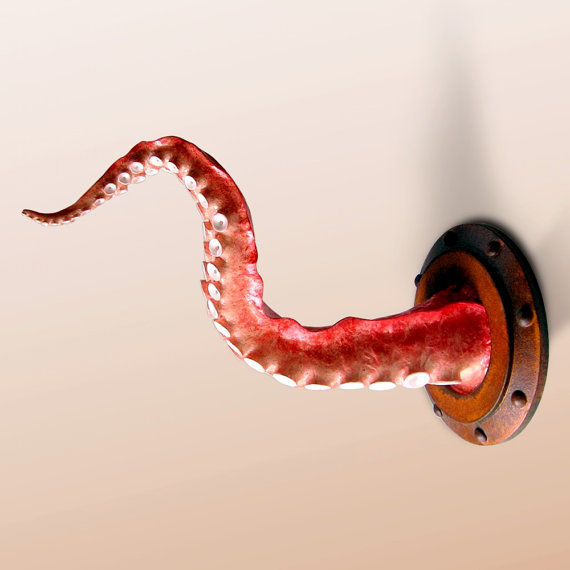
Got cats? Probably, if you're a writer. Or at least some other sort of pet. If you have cats, then you will need a secure and safe way to store them--so why not cat hangers? These cat hangers are durable and flexible, able to support and store any size or shape cat. I recommend grabbing some right away, before they sell out.

These hangers can work great in a closet, on a doorknob, or on any sort of horizontal bar or pole.

What furniture do you have in your house that inspires you and helps you write?

Click here to get blog posts (about cats, the universe, and everything) delivered to your inbox weekly!


The Cat Feet Sonnet

Here we are: on the internet. What will you find there? Cats. I mean, it is the internet after all. 

There are a million cat stories. Funny cat stories. Sad cat stories. Buzzfeed cat stories. Even boring cat stories that are somehow still interesting. Do you remember that story about that cat that took a nap?

cat-nap-face-down
after-my-cat-nap
cat-nap-ninety-percent
cat-nap-hard-place

Exactly.

Just google "Cat Nap Meme" and you'll have more than enough "boring"  entertainment/procrastination material for the afternoon.

But you know what people don't talk about often enough? Cat feet. No seriously. I think cat feet might be one of the most adorable things on the planet. 

LOOK AT THEM.

LOOK AT THEM.

No seriously. YOU'RE NOT LOOKING CLOSELY ENOUGH. LOOK.

No seriously. YOU'RE NOT LOOKING CLOSELY ENOUGH. LOOK.

Goblin's feet are blue because she walked over a picture I was working on done in soft pastel.IT'S BRAIN EXPLODINGLY ADORABLE. (I admit I am biased as these are my own cats.)

Goblin's feet are blue because she walked over a picture I was working on done in soft pastel.

IT'S BRAIN EXPLODINGLY ADORABLE. (I admit I am biased as these are my own cats.)

I mean... look at her face! It's basically perfect--or almost as close as you can get.

I mean... look at her face! It's basically perfect--or almost as close as you can get.

BUT LOOK AT THOSE FEET. LOOK.

BUT LOOK AT THOSE FEET. LOOK.

I mean, come on! Can it get any cuter???

So, to express my utter love and devotion for cat feet, I have decided to write a sonnet titled, "The Cat Feet Sonnet." After it, I will post numerous photos of cat feet, with the hope that one day, you too will share my love and admiration for their glorious beauty.

Enjoy.

The Cat Feet Sonnet

When I consider how cat feet are made,
Like tiny jewels of fluffy lemonade,
With deadly knives that hide so deep within,
I cannot help but think they are akin

To downy pillows if pillows had claws,
Or the inside of a slow loris's jaws,
Or a feather mattress filled with sharp blades,
Or a gentle rainstorm fused with grenades.

But the pitter and patter of cat feet,
The fluff, the soft, and the justice they mete:
There aren't words for the emotions that spread
When I see cat feet stick out of my bed.

The blood, the fear, and the pain that they cause
Is worth a glimpse of those elegant paws.

-By Ariele Sieling**

Pictures of Cat Feet

Toes.

Toes.

This is just too... FEET. Beautiful.

This is just too... FEET. Beautiful.

Dreaming, Goblin? About high fives?

Dreaming, Goblin? About high fives?

Paw curl of the gods.

Paw curl of the gods.

Rowan's paws are so furry they look like she's wearing adorably soft boxing gloves all the time.

Rowan's paws are so furry they look like she's wearing adorably soft boxing gloves all the time.

I swear it helps me work when he sits on my lap like this! Particularly when he starts writing poetry. A poem by Wilfred goes something like this: kja;hoijsf; hisofak;lsdjf ohaifihoj ji;lf;l;ajlkf jkl;

I swear it helps me work when he sits on my lap like this! Particularly when he starts writing poetry. A poem by Wilfred goes something like this: 
kja;hoijsf; hisofak;lsdjf oh
aifihoj ji;lf;l;ajlkf jkl;

Tell me that's not perfect, and I'll show you the claws. 

Tell me that's not perfect, and I'll show you the claws. 

And there you have it. Cat feet are amazing. 

Now, just don't get me started on cat tails. ;)

wilfreds-adorable-cat-tail


Bonus Reel: The Lost Stanza

This is a stanza I deleted to make it 14 lines (which apparently is a requirement for Sonnets): 

And I liken it to a honey bee
The insect more lovely than a peach tree
Brown fuzz covering it from head to bum
With a sharp stinger to give it aplomb.

**Disclaimer: I used a rhyming dictionary to write this. Also a thesaurus. And my fingers (to count syllables).

Click here to get blog posts (about cats, the universe, and everything) delivered to your inbox weekly!

A Man Named Jack: A Story From WWII

I once met a man named Jack.

Me with Jack (John R. Williams).

Me with Jack (John R. Williams).

I was 15 and Jack was 85. The meeting was simple. I had to interview someone who had lived during WWII for a high school history project. He came to my parents' house, and we sat at the kitchen table and talked while I scribbled illegible notes and he pulled photo after photo out of his binder. 

I had a list of interview questions provided by my history teacher, and he came well prepared with stories, photographs, newspaper clippings, and documents. But it's only now that I'm realizing exactly what story Jack had come prepared to tell.

Born in 1918, Jack grew up on a farm. His mother passed away early in his life, and when his father remarried, they didn't have room for everyone and he went to live with his aunt and uncle. In 1941, he married his beautiful wife Edith, the same year that the Japanese bombed Pearl Harbor and the US subsequently joined the war.

All around him, men were joining or being drafted into the military. Jack was never drafted, but he felt a sense of guilt, so in 1942, only 10 months after marrying Edith, he enlisted. In 1943 he began his work with the Navy in Camp Endicott, Davisville, RI.

john-williams-portrait

He explained, "I felt it was necessary to join because if we didn't stop the Axis, then they would have overrun everybody. I don't like aggressiveness and terrorist ways because those people want power and as a result, many innocent people die and are affected. If we hadn't stopped the Axis, then their aggression would have been worldwide."

As a civilian, Jack worked as a fire watch on a boat. There, he learned to weld from an alcoholic welder. He became so skilled that when he joined the Navy, he was assigned to make gun mounts and bucket gun mounts for anti-aircraft guns. They placed him with the Seabees, a branch of the Navy that went ahead of the army and prepared a place for them to live and work. He spent 4 years serving his country.

Jack's Seabees unit worked all over the South Pacific, visiting places such as Vella Lavella, Guadalcanal, and Okinawa. They worked fiercely during the day to prepare the area for the arrival of the army, and spent their nights shooting at Japanese planes who were attempting to delay their progress. They ate K-rations, deer, fish, and turtles (depending on what island they were on). He remembered a visit from Bob Hope and that they fought in Vella Lavella, but the details of those days and nights weren't clear any more. "Experiences fade after a while," he explained, "and then they aren't as interesting any more."

His journals from the time tell a slightly different story, however. 

"Saturday, Sept 11 1943.
"Last night was one of the worst nights we've spent since we've landed, as far as our raids are concerned. A raider came in from the NE corner of the strip, directly toward our tent, and dropped two bombs in rapid succession about 250 yards from our fox hole. The heaviest curtain of shell fire that I've ever seen kept the raider rather high thereafter. One of our fighters finally appeared and made it possible for us to get some sleep.
journal-1.JPG
"Sunday, Sept 12, 1943.
"We had a much better night last night. There were several alerts but no raids. Our planes raised hell with Kolom - Ongara. They pattern-bombed it all night. Two Jap destroyers tried to make a landing on Vella Lavella during the night but were driven off by P.T. boats. Worked 1/2 day.
"Sept 14.
"Last night at 11:35 all hell broke loose. Tojo laid an egg/daisy cutter 15 ft from our tent and about 25 ft from our fox hole. Pat Begley never left his tent. A piece of shrapnel caught him in the right temple, splitting his head in half. Shattuck lost his right arm between the elbow and shoulder. Castner got his leg hurt by a shrapnel and his eye hurt making a dive for the fox hole. I got peppered by shrapnel in the leg, back, and shoulder. I was afraid to move either leg or arm for fear they wouldn't work. There is about 18 fellows injured + 8 tents blowed up. I'll never forget the nerve-shattering, ear-piercing blast of that bomb or the heart-breaking moans and cries of fellow mates in agony. Trees fell all the rest of the night due to the concussion."
Jack (far right) and his comrades that survived the daisy cutter.

Jack (far right) and his comrades that survived the daisy cutter.

Despite the hard work, despite the fear, and despite the loneliness, Jack kept going, fighting for a cause that he believed in. "I had an implicit faith in God," Jack told me, "because he was there all the time."

When asked, "What do you feel was the most significant moment during your time serving in WWII." He replied, "When I saw my friends and comrades die right next to me, I wondered why I wasn't next."

jacks-purple-heart-award

In January of 1945, Jack was awarded the Purple Heart for the wounds he received on Valla Lavella. A few months later, in October, Jack was honorably discharged, returned stateside, and began working at Picatinny Arsenal in New Jersey. He stayed there for 32 years. After his retirement he moved to Bath, NY where he wrote poetry, spoke at service organizations, and volunteered at the Bath VA.

He passed away on September 9, 2012.

His story is deep, profound, and moving, but it's not the only one. Hundreds of thousands of service men and women, of all races, faiths, and ideologies have served, fought, been wounded, and died to protect their country. And those that have returned deserve kindness, respect, and love.

On this Memorial Day, salute the flag and find a way to help a veteran, whether you're in New Hampshire, New York, or anywhere else. We need them, and they need us.

I'm going to leave you with a poem, written by the wonderful and humble John (Jack) R. Williams, titled "Voices On A Hilltop."

Voices On A Hilltop

I climbed that Hill to be alone,
to gaze down at the scene below.
With a heavy heart and tear-filled eyes,
I beheld endless White Markers, row after row.

Each marked clearly with a Hero's name,
Name and Rank of AMERICA's best.
At last, with life's battles over,
Our Heroes, in GOD'S care, can Rest.

One's mind can never imagine
All the heartache, suffering, and pain
That's represented by each of the Markers
And the sound of the "TAPS" mournful refrain.

I sought to be alone on that hilltop,
But my efforts were all in vain,
the memories of Fallen Comrades
kept roaring through my brain.

As I glanced once again at those Markers,
a message seemed to tug at my heart.
Voices seemed to rise in unison:
"DO NOT FORGET ME, I'VE DONE MY PART."

Some of the Markers, in the form of a Cross,
Had a special meaning to me,
They brought the image of "Sacrifice,"
as the One on Calvary.

You don't have to be on that Hilltop
you can be anywhere, perhaps in a comfortable chair.
Just picture those rows of Markers,
Remember those Heroes in your prayers.

-John R. Williams, Shipfitter First Class (CW, USNR)

Jack as a young boy.

Jack as a young boy.

Jack with a P-38 warplane. When the US introduced these new powerful engines, the Japanese thought the US was so short on pilots that they had one pilot flying 2 planes at once.

Jack with a P-38 warplane. When the US introduced these new powerful engines, the Japanese thought the US was so short on pilots that they had one pilot flying 2 planes at once.

Jack with two of his friends in the South Pacific.

Jack with two of his friends in the South Pacific.

Jack receiving his Purple Heart.

Jack receiving his Purple Heart.

A ship in the South Pacific. Mail arrived on ships like this.

A ship in the South Pacific. Mail arrived on ships like this.

Disclaimer: This post was written using material from an interview which took place 12  years ago and an essay written by a 15-year-old. If you see an error, let me know and I'll do my best to fix it!

Click here to get blog posts (about liberty, the universe, and everything) delivered to your inbox weekly!

Adventures of a Freelancer: The Strategic Approach

There's a lot of work out in the big wide world, and since I started freelancing full time, I've taken a step back and tried to take a more strategic look at what work I apply for and what work I accept. 

When I first started full time, there was a powerful urge to accept every offer that crossed my desk because, you know, ELECTRIC, INTERNET, MORTGAGE, GAS, FOOD, AHHH!!! But the more research I did and the more offers I considered, the more I realized that I didn't have to worry about ELECTRIC, INTERNET, MORTGAGE, GAS, FOOD as much as I had to be careful not to screw myself over. Because then, guess what? LAWYER FEES, FINES, JAIL!!!   

So here are few things I have learned, coming out of the full-time freelancing gate like a cat out of the bathtub.

This is exactly how I entered the freelancing world, growling and clawing and soaking wet.

This is exactly how I entered the freelancing world, growling and clawing and soaking wet.

Time Commitments

One of my favourite things about being a freelance writer is that I get to decide what I work on and when, provided of course that I meet my deadlines. This means that I can go lie in the hammock in the middle of the afternoon, or go visit my grandmother if I get a hankering, and finish my work late at night or early in the morning.

Don't stare at this for too long.

Don't stare at this for too long.

That said, it always confuses me when people are looking for low-cost freelancers who will commit a lot of hours under a rigid schedule for a long time. It makes sense for a three week contract job, or even a three month contract job. But for years of labor? I might as well be a full time employee of the company... minus the benefits.

Let me give you an example. I was offered a job to do academic copy editing. One of the value adds the company offered their clients was 24-hour turnaround, so they wanted editors that could turn things around quickly. So far so good. However, they wanted a time commitment from the freelancer of a minimum of 8 projects a week (these projects could take anywhere from 2 - 5 hours to complete), each of which had a day-of deadline and only paid $15/hour (it was per project, but this was their estimated hourly rate). 

So, if you took 8 five-hour projects, you would already be working 40 hours that week, not counting any other projects you might have going on, and not leaving any flexibility for fitting in things like going to the gym or picking up kids.

I had another company that wanted me to work 35 hours a week for 2 - 3 years (or more). 35 hours a week isn't quite full time, but doesn't leave enough hours to really expand your business and work for a variety of clients. Even if you worked 60 hours every week for 2 - 3 years, you wouldn't be able to have very many clients. I told the company that I would be willing to do 35 hours a week for a few months, but then I would want more flexibility to fulfill the terms of my other contracts, but they said no. No flexibility allowed. 

I call this piece, "Eggs No Mo."

I call this piece, "Eggs No Mo."

To me, taking this kind of high-hour, long-term (not to mention low-paid) work from an unknown entity is like putting all of your eggs in one basket (where you don't know if the basket is made of steel or twigs), especially if freelancing is your only source of income. If I had taken the 35 hour a week job, and then they fired me or suddenly had a drop in contract work, all I would have had left was the 10-hour per week job that I had taken on to fill in the gap. Whereas, if I took 5 ten-hour a week jobs and lost one, I would still have 4 other jobs left to help pay the bills.

Non-Competes

Non-competes are good when they protect both the freelancer and the company. However, they catch people up all the time, and while I'm no lawyer, I'm extremely picky about what ones I'm willing to sign. I'm happy to agree to not recruit a company's staff to work for me. I'm happy to agree to not work for a direct competitor. But there are plenty of other things a company can stick in a non-compete that are ridiculous/potentially conflicting and can get you screwed without you even realizing what's happening. 

A friend of a friend decided to start up a freelance consulting business, and her first contract was for her state government, as that's where the majority of her experience was. She signed the non-compete without understanding what it said. When she went to go work for other state governments, hers said, "uh... nope! That's against the terms of your non-compete!" The non-compete had forbidden her from working for any other government for a full year after her current employment was terminated. Which is ridiculous, as that's the entirety of her consulting work. She had to go back and renegotiate her contract, and they eventually agreed to let her consult for state governments outside of New England.

When I read an over-the-top non-compete, I feel the same way Fry does when he sees a picture of a soul-stealing alien.

When I read an over-the-top non-compete, I feel the same way Fry does when he sees a picture of a soul-stealing alien.

I had non-compete presented to me (which I ended up not signing), that was so full of legalese I had to take it to a lawyer to understand what it meant. Ultimately, the non-compete restricted me from working for all competitors, anyone in the industry, even clients (who weren't defined in the document, but who could be classified as anyone purchasing their services, which in this case could have been your mom or grandpa), and even financial institutions who worked in the industry! That would have restricted my potential employers significantly going forward, not to mention that the non-compete was valid for 2 years, and the penalties for violation started at a quarter of a million dollars. Luckily, I'm a writer and my skills are helpful across industries, but I felt it would be unduly unwise to sign something so restrictive, particularly as it was not very lucrative.

The other thing about non-competes is making sure that the new ones don't conflict with any existing ones. I like to periodically go back to the non-competes I've already signed and make sure I can actually remember what they say. This way, when new ones arise, I can make sure I'm not getting myself into any tight spots.

So yeah, watch out for those non-competes.

Online Platforms that Take a Cut

There are a wide variety of online platforms that offer freelance work of all sorts: eLance, Fiverr, PeoplePerHour, Writers' Access (to name a few), and as you know from my post about check fraud there are some pretty sketchy people and job offers out there. In addition to those people, there are the platforms themselves. Pretty much all of them are basically "what you see is what you get." Take Fiverr--what do you expect on this site? $5 jobs? You can make a lot if you're good at it and don't care about quality, but, it is what it is.

Anyway, when I first began freelancing, I started by poking around on PeoplePerHour, and I applied for some blog post gigs. They were about $40 for five 300-word blog posts. I figured if I could bust each post out in a half hour or less, than it would be worth it. So I did--5 blog posts in 2.5 hours. I did two sets of these for the buyer, and the buyer paid me $40 each through PeoplePerHour. Then I had it transferred over to Paypal. Between the PeoplePerHour fees and the Paypal fees, what should have been a $78 check turned into a $64 check, bringing my hourly rate down by $3. That's somewhere around 18% (this was probably mentioned in the PPH agreement, which clearly I did not read carefully enough)! I have no problem with a platform like that taking a cut, but I learned that I had better take that into serious consideration when accepting jobs. 

No but seriously, this gif is the perfect representation of my feelings.

No but seriously, this gif is the perfect representation of my feelings.

So my current strategy is to keep my options open and flexible, read and understand every word of non-competes and other legal documentation, and not take low paying jobs on online platforms. 

I'd love to hear how you approach your assignment choosing--what strategies do you use? Any bad experiences?


Click here to get blog posts (about freelancing, the universe, and everything) delivered to your inbox weekly!

I Have A Complicated Relationship With Chickens

My neighbors have chickens. All day, every day, I stare at them and think to myself: man, they have a good life. Especially these chickens. Think about it. A cute little house puts a roof over their heads (I wouldn't be surprised if it was heated). They get fed multiple times a day. They have no stresses, unless you count wild animals, but honestly, they're not wild chickens. They have a fence that protects them, and, in this case, a fence roof too! So they don't even have to worry about dragons or eagles. They spend their days pecking away at the dirt, and digging holes to try to escape from out of their fence. 

In the mornings, I listen to them cackle after they've laid eggs, and sometimes when they escape into my yard, I get some exercise chasing them around, and some amusement at watching them freak out. (Chickens are really dumb).

When I was a kid we had a lot of chickens. Like 30, though a little book I made in elementary school says we had 50. I don't know who to trust, my book or my mom. I was the best chicken catcher in the family. Case in point: 

This is me (in blue) and my brother Gary (in red). At this point in my life, I was only slightly larger than the chickens. They probably thought I was a chicken too.

This is me (in blue) and my brother Gary (in red). At this point in my life, I was only slightly larger than the chickens. They probably thought I was a chicken too.

I used to collect the eggs, after chasing all of the birds out of the coop. One day, there was a big ugly old rooster who refused to leave, so I was just like "whatever" and ducked under the roost to get the eggs. When I turned around, basket full and ready to leave, he was just sitting on the roost, staring at me. 

I glared back for a moment, and then ducked under the roost to leave. This is when I learned my lesson: DO NOT EVER DUCK UNDER AN UGLY OLD YELLOW ROOSTER.

He jumped on my head. Claws in all. I was probably not older than 10, so I screamed and ran (though to be fair, I think even an adult would have screamed if a rooster had dug its claws into their skull). I threw the eggs. My parents were not pleased with the rooster's behavior.

I'm pretty sure we ate that rooster.

This is the coop. My parents use it for ducks now. It used to have a swinging door on it; now the ramp flips up into the door.

This is the coop. My parents use it for ducks now. It used to have a swinging door on it; now the ramp flips up into the door.

A second incident occurred a few years later when I was a teenager. We only had 5 hens and 1 rooster at this point, all black and living in a small pen near the house. My chore was simply to get the eggs. But the rooster had gotten it in his head to guard the hen house, so I was having a heck of a time getting anywhere near it as he chased me every time I tried.

Then, my shoe got stuck in the mud. I started hopping around the little house on one foot with an angry rooster chasing me. Then, as I came around the other side, I grabbed the door of the house swung it back, hitting him squarely in the face. 

He was stunned, and stumbled into the back yard while I rapidly grabbed the eggs and my shoe and exited the fence as quickly as I could. Hilarious, I might add. The whole thing. I love telling that story, even if no one else is particularly interested, mostly because I won and the rooster did not. Triumph over the poultry!

My relationships with other forms of poultry have not been nearly as eventful. Mr. Goose was a dearly beloved animal. My dad had a variety of beautiful pigeons (King Featherfoot, Skye, and Blackie, to name a few). We had peacocks and turkeys, and now my parents have ducks.


Mr. Goose, the best Toulouse goose in the universe.

Mr. Goose, the best Toulouse goose in the universe.

Two peahens with a peachick.

Two peahens with a peachick.

My mom's very cute and very needy ducks.

My mom's very cute and very needy ducks.

Charles the cat and George the peacock discussing the stock market.

Charles the cat and George the peacock discussing the stock market.

And now I sit in my condo, and watch my neighbors chickens, and think to myself: I'd like to get chickens. Or ducks. Or peacocks. 

One day, I will.

Click to get blog posts (about poultry, the universe, and everything) delivered to your inbox weekly!