Honey Bees and Dirty Feet

Last week I went home. And by home, I mean that place where I grew up with my brothers, parents, and quite a few animals of various species. The animal population has decreased significantly since I was home for a visit last. They are down to two cats, one dog, and five ducks.

As long as we are talking about ducks, let me mention that ducks are stupid. I mean, really, really dumb. Let me give you an example. I threw a green bean at them. They were so terrified of that bloody bean that they plastered themselves to the back wall of their little house for hours. Later, my mom put out a tray of lettuce, and one duck was so terrified, it got trapped between the lettuce and their swimming pool, unable to get to the safety of its duck house. 

Dumb. And hilarious.

ariele-with-ducks

But what I was really home for were bees. Bees. Beekeeping. Honey. The Honey Harvest Open House, to be precise. Each year, my parents and I host an event where the community can come over to our house, watch us extract honey from the hives, and learn about beekeeping, honey, wasps, and more. We have had a very positive response, and it's a lot of fun to do.

In preparation, we spent two days cleaning and prepping the bees. My dad and I had a lot of fun wandering around with bees on sticks.

This was part of a dry swarm that had been sitting in a tree for a few days.

This was part of a dry swarm that had been sitting in a tree for a few days.

This is my dad pulling some frames out to look for queens. On this frame, the bees have built some very interesting-looking comb.

This is my dad pulling some frames out to look for queens. On this frame, the bees have built some very interesting-looking comb.

Of course, extracting honey is never as simple as you expect it to be. So while we were preparing, we ran across three separate swarms, all of which were dry, meaning they'd been out of the hive for a couple of days and had started to build comb. One was 20 feet up in a tree, and we decided it was too difficult to get to. The others were low to the ground, so we captured them, just to give them a chance over the winter. 

This is us putting the swarm in a hive.

Once we took care of the swarms, though, we were able to grab a few supers of honey and cart them down to the honey room. Then, we let the event commence!

I, being a volunteer, was allowed to sell my books at this event. So that was fun, too. Plus I get to see people I knew a long time ago, which is also fun, and family.

Basically, my dad did live bee presentations and my mom sold stuff while I extracted the honey from the hives. I wish there were two of me. That would have made the whole day a million times easier. But we had friends helping out this time, and it was a whopping success.

And there you have it: one particular day in the life of Ariele Sieling the 1st, author.

Here is a wonderful gallery of pictures from the day:

And as you saw in the first video, I do tend to wander around barefoot or in flipflops. So in case you have ever wondered what feet look like covered with honey and dirt, I will leave you with this:

Long story short: it's not pretty. :)

But, if you happen to be anywhere near Bath, NY next year, come to the Honey Harvest Open House, where you will find bees, honey, and local authors. :)

Wounded World Book Trailer: Behind the Scenes

Last month, I worked with some absolutely amazing human beings to create a book trailer for my upcoming novel, The Wounded World. Not only do I adore the art that was created, but I loved working with such a driven, cheerful, and professional team. Hats off to Julie Lawlor and Evan Sieling.

The book trailer was hatched as part of a larger scheme to promote the release of The Wounded World, and thus far we have received an overwhelmingly positive response.  Check it out!

Some of my favourite bits are the first shot, of Evan's foot coming down with a boom; the heartbeat sound effects; the ticking clock sound effects; the running fast shot from the side; and the very end when it ends with THE WOUNDED WORLD in big text. 

The process went something like this: 

  1. Ariele had an idea.
  2. Ariele talked to Julie. Julie was on board.
  3. Ariele talked to Evan. Evan was on board.
  4. Evan flew to NH.
  5. The crew did 2 hours of filming.
  6. Evan went home.
  7. Julie pieced together the trailer.
  8. Evan built the soundtrack.
  9. Julie put the pieces together.
  10. Ariele loved it and suggested some minor changes.
  11. Evan and Julie made said minor changes.
  12. It was published. Wooooooo!

During filming, Ariele's other friend, Josh, took some additional video footage, just for kicks. 

All in all, we had perfect weather (despite the downpour that happened 20 min before filming) and the whole project was seamless. Here are a few pictures.

Stay tuned for the release of The Wounded World on October 9th!!!

The Wounded World Cover Reveal

Guess what! The day is finally here! This book, The Wounded World, is the culmination of 5 years of work. Blood, guts, and tears were all spilled for the birth of my precious novel (just kidding about the guts part. Maybe.).

Today I am proud to reveal it's cover. Ladies and gentlemen, The Wounded World: 

The Cover of The Wounded World, by Ariele Sieling

The Wounded World tells the story of Quin and his father. Upon returning to Pomegranate City, Quin discovers that his father has disappeared, taking with him knowledge that is very precious to his government and leaving behind a very dangerous new Door. As he sets out on his journey to find his father, Quin hopes that he hasn't stumbled onto a problem so big he cannot even begin to solve it. 

Followed closely by his good friend John, Quin travels from world to world seeking answers... but will he find them in time?

Written as a prequel the other two books in the series, this science fiction tale takes the reader from humor to heartbreak in one simply journey.

A Strange House: a non-excerpt from The Wounded World

This is a piece I wrote to help me characterize a certain individual in my next book: Meriym. Although this excerpt will not actually appear in the novel itself, it played a huge role in the plot development of my current NanoWriMo project. Enjoy!

wounded-world-grass.jpg

Footsteps thundered in the silent and empty air, magnified by the hollowness of the space under the bridge; Meriym was running, terrified of the thing that chased her. Sweat dripped from every inch of her skin, and droplets of blood leaked from her hands where her nails pierced her fists from the intensity of her grip. She gasped and ran, one foot after another, praying for salvation and never looking behind her.

And then she tripped. The world slowed around her as she saw the brown and dusty earth rise up to embrace her – every speck of dirt seemed to float slowly by her eyes. The hungry, blade-like grass lashed at her arms leaving a trail of blood across her skin. A crow screeched overhead. She bounced a little on the hard ground, and then, with gritted teeth, rolled over to face the thing that chased her. The sky was greyish-blue, as if the sun hadn’t quite finished rising. And the path behind her lay empty.

She sat for a few moments, her chest heaving, gasping for much-needed air. Her hands feebly felt the ground around her. Her eyes took in the colours, the sights, the bridge – she was nowhere, yet she was safe. For the moment.

Standing slowly, she brushed off her skirts. Where had it gone – the thing that had chased her? A frown settled over her hardened eyes. What if it had the power to become invisible? She may not be safe after all.

Meriym turned and strode down the path, away from the bridge. There must be someone in this new world that could help her, protect her. She walked slowly, listening, hardly breathing, looking in every direction. With patience and perseverance she could – she would – outwit the creature. She would kill it, and every creature like it, revenge for destroying her people. She squared her shoulders and lifted her chin, only to see a strange shape emerging from just over the rise.

Hastening, Meriym’s eyes widened as she saw the strangest-looking house. Each side was perfectly square, and the four sections of roof peaked together in perfect isosceles triangles. Each side contained two windows and one door; the door was placed perfectly in the center and reached all the way to the top of the wall. The doorknob stuck out in precisely the middle of the door. The only thing that was not symmetrical in every direction was the set of steps that led up to each door on each side of the house.

Despite the uncomfortable balance of the building, the steps had begun to rot, and small tufts of grass grew through their weakened wood. Square shingles lay broken on the ground. A deep, dry, and unforgiving field spread out in all directions, with only one path leading away from the house towards the river which flowed a deep and unnatural red.

The house was odd, unusual, and utterly foreign. But it was a house and it appeared abandoned. Meriym swallowed and stepped towards it. With time, patience, and perseverance, it would become her fortress.

The Art of Telling Stories: Aurora Gordon

The Art of Telling Stories is a series of posts designed to take a deeper look at what it means to tell a story. Writers tell stories constantly, but many other people in many other vocations tell their stories as well, but in other, often more subtle, ways.

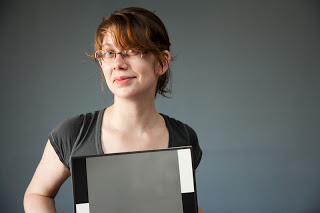
Today's guest is Aurora Gordon, a dailies colorist for television, a video producer, and a brilliant artist. You can check out her newest trailer about the Daily Ocean as well as several of her other projects on her website or on Vimeo. In addition, the image to the right is one in a series of nine that will be available to benefit the Red Cross of Oklahoma with the recent tornado damage.

Aurora, tell us a little bit about yourself.

I'm a dailies colorist for television - and that means I'm the one applying a look to the footage
immediately after it was shot (so I work the graveyard shift, yikes!). We do this so that the footage will look as close to the final intention as possible for the rough cuts before the footage goes to a final color session for polishing, and eventually broadcasting on TV. In ideal situations I talk to the DP beforehand, and we discuss what sort of look he's going for.  Then it's up to me to come up with the right "cocktail" of dial pushes to recreate that everyday.  I go through all the footage and make sure if more than one camera is used that both cameras have the same color balance.  So, if B Camera looks too blue compared to A Camera, I'll either add yellow to B Camera, or add blue to A Camera.

What that means in reality: I stare at monitors overnight and turn knobs and roll track balls!

In my daytime I'm a video producer and lately I've been working on a documentary about a woman who goes to clean up the beach 20 minutes at a time.  I work mostly on personal documentary style projects but I've been known to take a commission or two. Especially if it means working with an awesome small business.

How would you define storytelling?

Wow, storytelling defined!  I'd say good storytelling is forgetting about your ego and relaying events in a generous, affordable, relatable way. Being a liaison to the world - even if it's a small story.


Would you consider yourself a storyteller? Why?

Definitely.  I used to get asked a lot, are you ever going to specialize and focus on just videos, or just color? And I think it's a lot of the same skill set.  To me it's almost the same job.  As a storyteller you have to get this idea in your head out to an audience - and as a colorist I have to get the idea in the DP's head out to the audience. But, there's still a lot of room for my interpretation.  For example if someone says to me "Make this scene warm!" my first image is a slightly yellowed cozy kitchen, probably with something being baked for hungry guests in the oven.  So I'll then grade the scene with my interpretation of warm - gold familiarity.  But another colorist might grade it like a warm body on a beach - almost red. I live in a land of subtlety and perhaps it's hard for a lot of people to understand nonverbal storytelling as the same as Storytelling with a capital S - but that's what I like to think I do best: subtly transfer feelings.


How do you decide what images tell the story and what ones don't?

When I'm cutting a documentary project, I'm just ruthless. I ask myself: what's the most important image here, and what am I really trying to say?  Does this other image inform and support that? No?  On the cutting room floor it goes then. Another good question to ask is: Would an alien get this image?  Hopefully it's powerful enough some creature from Mars would even understand.


What impact does colour have on the story being told?

Ah - this is a good question. Like I said before, it's a nonverbal art form. I think really great color can take a cold, steely scene from a movie like Skyfall, and make a lonely spy trapped in solitary confinement relatable to everybody's life. What's actually on screen might be a creepy dude with a bad attitude and a bionic jaw, but everybody has a time in their life that was blue and steely and lonely. Sometimes it's easier to say with a look than words.


Do you think you could tell a story with just colour? How?

I think there are color arcs like there are story arcs. I don't know if I could just pop colors on screen and say something a viewer could understand though. I do think oftentimes the color really confirms what you're seeing.  For example, oftentimes movies will end warmer than they started.  If it's a happy ending, it probably looks a little rosy too.  A filmmaker can dial in a look that says, "You might not feel this way, but here's how I want you to feel."  I think a stylized look can be a really honest tip of the hat to the fact the story is of course coming from a biased and subjective point of view.  For example, Wes Anderson always uses his yellowed, aged, signature look and I think that's a nice way to subtly say to the audience, "This is my fading memory and it may or may not be what's really occurring in the world."

But I also think there can be stories told with color in homes.  I'm fascinated with the way people choose to decorate and paint walls. I think there's a reason some people have dark walls and some people have light walls.

What is your favourite part of the work you do and why?

My favorite part is probably the moment before I dial it in.  (Do people know what that means?  We say a scene is "dialed in" when we've got the knobs literally dialed in to the right position. It's another way to say "nailed it.")

When I'm working on a challenging scene I might go back and forth with 10 different versions that are all minor, minor changes, but from version 1 all the way to version 10 is cumulatively a big change.  I like the challenging scenes because oftentimes the moment before it's dialed in is the moment I try something new and discover a new way to combine shadow, midtone, and highlight color values.


What is your favourite colour?

Green!  Our eyes are most sensitive to around 550 nm, which is about green. So I like green because it illuminates most things for humans.

Also, when my husband James first met me he insisted I have green eyes, even though my driver's license and everybody else in my life says I have blue eyes.  He sees me green instead and it makes me laugh.


Is there anything else you would like me to share?

Eat your vegetables! Play with animals! Don't buy things that sell you another version of yourself!


Don't forget to visit Rory's website to learn more about what she does and what she can do for you!